Come and eat!

Wise women have said the way to a man’s heart is through his stomach. I believe it.

When Nate and I got married, he came to me from a childhood of enjoying the creative cooking of his mother, Lois. She had a lavish cook book collection and used it often. As a newlywed, I realized I’d have to learn to cook if I was going to make my man happy.

Fortunately there was an effective buffer between Lois’ high-class dinners and my incompetence in the kitchen: university food.

Nate’s memory of those home-cooked meals dimmed as he ate in college dining halls from 1963 until we married in 1969, and his expectations were wonderfully low.

After 40 years of cooking thousands of meals for him, I remember only one word of criticism. I’d made a teriyaki stir fry, one of his favorites, but the sauce had turned out thin. Because it wouldn’t stick to the veggies or meat, I used a tip from Mom, adding a bit of corn starch to thicken the juices.

When Nate came to the table, he saw what we were having and said, “Mmmmm. Stir fry!”

We all sat down, heaped food on our plates and dug in. Nate had already eaten three forkfuls by the time I took my first. “My word!” I said. “What’s wrong with this stuff?”

That’s when Nate’s criticism came. “I kept trying, because I couldn’t believe it tasted so awful. What did you do to it?”

“I have no idea,” I said, walking my plate toward the disposal. That’s when I noticed the corn starch on the counter. Unfortunately, it was really baking soda. How I’d mixed up an orange box with a white can I’ll never know. But after we’d all enjoyed frozen pizza, we had a good laugh over my error.

Although I never became a skilled cook, I did learn one valuable principle preparing meals for a big family each day. More important than flavor, smell, ingredients or presentation was volume. Everyone was happier with a full stomach, and filling them up became my #1 priority.

Nutritionists might label that eating-suicide saying, “The food pyramid should be #1.” But my experience was that not having enough was worse than having only some of a perfectly balanced meal.
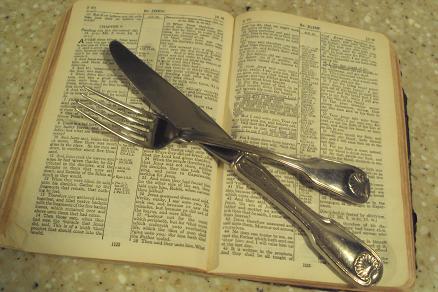
This principle works well with our spiritual eating, too. We can hold out for a gourmet meal: a peaceful place to read the Bible, a notebook to write in, a pen that works and a set of commentaries. We can wait to pray until we’re sure of uninterrupted time. But if we do, we’ll always be on the edge of spiritual starvation without enough to eat.

God is well aware of our fast-paced lives but creatively delivers spiritual nourishment as our appetites for him grow.

Scripture refers to its words as milk (for beginners) and meat (for the more advanced) and encourages us to taste it. So apparently the old adage does have some truth to it: the way to a person’s true heart is indeed through the stomach.

Do not work for food that spoils, but for food that endures to eternal life, which the Son of Man will give you.” (John 6:27)

Sniffing the Road

When Jack and I take our late-night walks, sometimes we don’t need a flashlight, but I carry one anyway. If a car approaches, I turn it on and point it toward Jack, since a driver might not see a black dog at night.

Once in a while when it’s time to take our last walk of the day, Jack is already dozing. If he’s been sleeping hard, it takes a few minutes to perk him up, even out in the cold. Some nights he drags behind me as if he’s walking in his sleep.

Last night was one of those nights, and since it was after 1:00 am, I wanted him to tend to business quickly. Trying to hurry him along, I whistled, then pretended to run ahead.  I even tossed a snowball down the road shouting, “Fetch!” Nothing helped.

Then I got an idea. I took out the flashlight and pointed it just ahead of my footsteps. The minute I did, he trotted from 20 feet behind me to just in front, walking near the light. If I moved the beam forward, he sped up. If I moved it back, he slowed down, as if he wasn’t sure of his step without seeing it clearly.

I could only conclude Jack doesn’t see very well. Most dogs have a keen sense of smell, #1 among their five senses. Jack walks along sniffing the road with high hopes he’ll smell something good. Suddenly he’ll pause to focus for several minutes on the same stinky spot, like we might pause in front of a beautiful painting, trying to take it in. It’s all about fun with his nose. Vision is probably at the bottom of a dog’s senses-list.

Since Nate died, sometimes I walk through life just like Jack, head down, “sniffing the road,” unsure of my step in the dark. But when I do that, opportunities get missed. There are people with eyes, like me, and then there are people with vision. Those with vision can see beyond what their eyes are looking at to what’s happening around them and what’s possible down the road. By comparison, I’m looking with tunnel vision.

Jack doesn’t worry about what he does or doesn’t see, because his well-developed nose compensates for his eyes. But I don’t have that advantage. Thankfully, though, God has perfect senses and is willing to use them for my benefit. He’s also a visionary, so he sees it all, everything that’s hidden in the dark and all the unseen possibilities still ahead. Much to my relief, he sees me, too, trudging along, “sniffing the road.” Since I can’t “smell opportunity,” I count on him to turn my head toward what he wants me to see.

One of my frequent prayers is that his messages will “hit me over the head.” Maybe I should add, “Do it with a flashlight.”


“The spirit is willing, but the flesh is weak.” (Mark 14:38b)


Letting Go, Part II

Last night, as Birgitta drove the five hours back to her college campus on icy roads, I stayed nervous until her text came through: “Just got here.” After that, I could breathe.

Life insists on our letting go of our children, but they aren’t the only ones. As we go through the years assigned to us, we have to say goodbye to parents, mentors, friends, pastors and others. Each positive relationship that has to end involves a negative go-moment.

The old expression, “When God closes a door, he opens a window,” means that when one situation ends, another begins. Every time we willingly let go of someone or something, we’re saying yes to whatever is outside that open window. Again and again God shows us that letting go of one thing opens up something else.

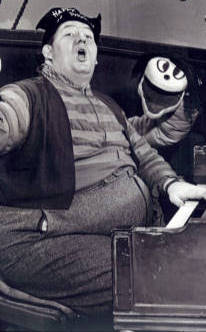
When I was a grade-schooler in the 1950’s, many of us walked home for lunch. Once in a while Mom would let us watch TV while we ate, and a 350-pound man who called himself Two-Ton Baker became our friend through the tiny, round screen.

Two-Ton loved kids, and occasionally he’d have one on his show to sing and banter with him. The child was always invited to grab a handful of candy from a giant glass jar, but a clenched fist full of goodies could never fit back through the small opening. The child would have to partially open his hand to get it out, thus letting go of some of the candy.

This is what happens when we try to hold onto someone or something after it’s time to let go. Our loss seems much greater the tighter we cling. Most departures have to happen anyway, and by hanging on, we lose the chance for a positive send-off. It’s as if we lose all the candy, not just some of it.

Sometimes, however, a go-moment just can’t go well. When a letting-go takes place next to a casket, it’s all negative. Someone precious has gone, and the slam of that closed door hurts deeply. A window may be opening, but we can’t see it through our crying.

God knows how difficult it is to let go. He let go of Jesus for 33 years after they’d been joined in a closeness we can’t begin to comprehend. And Jesus let go of his Father while simultaneously imposing human limitations on himself. He also let go of divinity and royalty to live in poverty. Their separation must have been excruciating, and yet they planned it and did it. The reason? Love of us.

Letting go is always an emotionally draining process. For a Christian who lets go of a loved one through death, however, the emotional pain will one day end abruptly.  Our separation is only temporary, just as it was for God the Father, and God the Son.

They endured. We can endure.

Because some day all our go-moments will be gathered up into one eternal coming-together.

“God blesses you who weep now, for in due time you will laugh.” (Luke 6:21b)