Shuffling Priorities

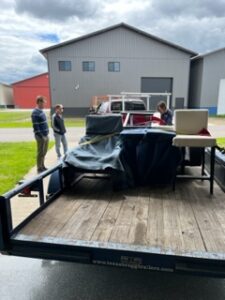
Last night Birgitta walked through my front door in a way different from all the others. After taking her last college exam yesterday, loading up her car, and driving the 5 hours between Iowa and Michigan, she moved back home for the foreseeable future, something she hasn’t done for 3 years except during short vacation stays.

The physical part of her moving day wasn’t difficult, but the emotional part was taxing. As she texted me before she left Iowa, “I think it’s really hitting me that this is it. It feels like I have to end my time being young and being in college here, so soon after I came.”

I reminded her there are many reasons why a college student might need to leave school. Two of her own brothers had to “pause” years ago when Nate and I needed to catch up financially. In Birgitta’s case, God has set a different agenda in front of her for now, and her move from campus to cottage yesterday was the first important step.

She’s been forced to turn away from university life for a while (possibly a many-years-long while) because she’s pregnant, and I couldn’t deny that her sad text was true. On top of that, yesterday’s many goodbyes were poignant reminders of the unexpected life-shuffle she’s undergoing:

  • She had to wave goodbye to roommates she loves, realizing with impact that their lives will continue in the same vein hers would have, had she not become pregnant.
  • She had to resign from a job she liked, say goodbye to her boss, and arrange to have her last check mailed to Michigan.
  • She had to say goodbye to the academics she relished and the diploma she’d intended to have in 2 short years.
  • And she said goodbye to the baby’s father, a young man she’s been with for 18 months.

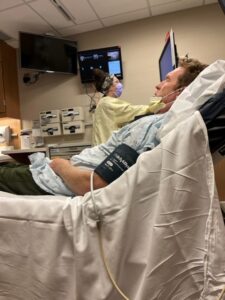
That’s a long list of endings without a matched set of beginnings. There is one big one, though: motherhood. Birgitta won’t be finishing her university education any time soon, but she will be starting an education of another sort. Despite there being no promise of a diploma at the end of it, she’s already putting her child ahead of herself, and I clearly saw that on her face in the doctor’s office this morning. When she heard her baby’s strong heartbeat, her grin stretched ear-to-ear.

It may not have been God’s best plan to conceive a baby before getting married, but it’s definitely his best now to recognize the importance of this new person coming to her and to all of us.

By joyfully putting him/her ahead of a degree and everything else, she can rest in knowing she’s doing the right thing. And by muscling through 4 painful goodbyes, she has successfully shuffled her priorities to make the new main thing, the only main thing.

“May the Lord answer you when you are in distress. May he send you help from the sanctuary… May he give you the desire of your heart and make all your plans succeed.” (Psalm 20:1,2,4)


A Reminder to Remember

After people die, their words gain in importance. We may have listened to what they said when they were with us, but we hear them with greater intensity after they’re gone.

For example, Nate chose a passage of Scripture as his favorite and never wavered as the years passed. Paul’s words in Hebrews 12:1-3 struck a chord with him because of the reference to running the particular race “set out before us” by God. In Nate’s view, each life-race looked different, some set on less strenuous courses than others, but our task was to run the one assigned to us, as best we could.

While Christmas shopping in December, I came across a tiny plaque with a portion of Hebrews 12 on it. When I saw it, I glommed onto it like it was a piece of Nate himself. Of course I know Scripture belongs to everyone, but the fact that it was his favorite passage linked it to him in a way that gave it more significance to me. Because he loved it, I’ll always love it.

The same holds true for someone’s personal belongings. Increased value post-death is what prevents a widow from cleaning out her husband’s closet or giving away what he owned. Even his scent, still hanging in the threads of his clothes, becomes precious, a reason to refrain from washing or dry cleaning his wardrobe.

Scripture makes good use of this principle. Jesus knew that those hearing his words were absorbing only part of the message while he was with them. Strangers listening on a hillside often turned and walked away, unable to believe the outrageous truths he taught. Religious authorities argued back; and his disciples suffered confusion. But Jesus knew that after his death, his words would take on greater potency, more effectively moving hearers to believe what he’d told them.

When a husband dies, that’s the end of his earthly existence, although his posthumous influence continues somewhat. But after Jesus died, he and his Father were ready with a plan that would not only continue his earthly influence but enlarge it to a world-shaking level.

He promised not to leave his followers as orphans [or widows] and said, “I will ask the Father, and he will give you another advocate to help you and be with you forever— the Spirit of truth.” (John 14:16-18) Since he’d just told them he was going away, causing them to feel low, this must have lifted them significantly. Then at Pentecost, they got their chance to meet this miraculous advocate, the Holy Spirit.

One of the Spirit’s many functions was (and is) to bring Jesus’ words and lessons to the remembrance of those he’d left behind (much like I remember Nate’s words) but to do so with added oomph, teaching and explaining what Jesus had meant in his earthly ministry. And he’s been doing it with excellence for 2000 years.

We can be forever thankful for this, because now that Jesus is no longer on the earth, what he taught has become especially precious to us.

Jesus said, “The Holy Spirit… will teach you all things and will remind you of everything I have said to you.” (John 14:26)

Hello, Goodbye

Thanksgiving is an easy holiday. The menu is always the same, and it’s difficult to mess up a turkey. Relatives and friends gather for laughter and good conversation like the “other big holiday,” but compared to that one, Thanksgiving is a walk in the park. No gifts to choose, pay for, wrap, send, or write thank you notes for. No boxes of decorations to put up and take down, and no giant tree to decorate. Easy.

Like all special holidays, though, there’s a down side. It’s fun to prepare for guests and welcome them as they arrive, but at the other end of the celebration, we have to say goodbye.

Hello, goodbye, hello, goodbye.

After a loved one dies, that one permanent, painful goodbye taints all the others. As Thanksgiving guests walk out the door and drive away, we wonder if we’ll see them again. Although this seems like a morbid conclusion to a happy day, the reality of a recent death marks us permanently. We wave goodbye with “maybe-the-last” in our minds.

I remember the agonizing process of saying goodbye to Nate. During his cancer, daily losses forced all of us to inwardly say goodbye a tiny bit each day. He did the same.

The last conversation I had with his oncologist (after he’d done all he could) involved admitting death was close. The trauma of knowing a final goodbye was just ahead was upsetting, and I was hanging onto each day like a child hangs onto his mommy each time she leaves him.

On the verge of panic, I asked the doctor, “What if I wake up one morning and find out he died during the night? What would I do!”

The doctor looked me square in the eye and said, “Consider it a gift.”

That answer was alarming. After many days of partnering with Nate as he steadily moved toward our final parting, I knew that if I couldn’t say goodbye, I’d be crushed.

As I watched him decline, gradually I saw how none of that was within my control. Only God knew the day and minute Nate would leave us, and unless I wanted to live in constant fear of missing my goodbye, I had to let God have it.

That’s actually a good thing to do with all our goodbyes. As we stand and wave, none of us knows what will happen next, but we can take comfort in knowing God does. Surrendering our goodbyes to him is simply the release of something we never controlled in the first place.

Although Nate and I did get our goodbye, if we hadn’t, I know God wouldn’t have let it crush me as I’d feared. Trusting him to tend to the details of our goodbyes (and what happens after them) gives us freedom to celebrate not just special gatherings like Thanksgiving but every get-together, all year long.

BTW, there’s one goodbye we’ll never have to experience:

“My Spirit, who is on you, will not depart from you.” (Isaiah59:21b)


Who am I?

Marriage is biblically described as two-becoming-one. A simple visual might be a husband and wife sharing one umbrella, huddled close, clutching the handle together. The two are together inside the one.

Widowhood is a loss of that oneness, which necessitates standing alone beneath the umbrella. That has a familiar feel to it, since independence was the starting point for all of us, but standing alone in widowhood, our umbrella isn’t as straight as it used to be. It flops side-to-side, and after managing it alone for a while, it gets very heavy.

Those of us who were married for decades find ourselves wondering what’s going to happen next. Some hurry into a second marriage, feeling lonely and uncomfortable with the mantle of singleness. Others try to turn back the clock hoping to remake youth’s decisions: a new job, new hairdo, new wardrobe.

A few risk their savings on precarious ventures in a quest for the money husbands once provided. A small number hurt so badly they burrow into widowhood as a permanent identity.

When I became a widow, wise advisers told me not to make any changes for a year. “Don’t move back to Chicago. Don’t give away Nate’s clothes. Don’t join anything. Don’t quit anything. Don’t even rearrange your furniture.”

But we widows find ourselves yearning for a revised life-purpose while still in that recommended holding pattern of preventing change. Eventually, though, the “don’ts” must morph into “do’s”. Although earthly life ended for our men when they died, it didn’t end for us, and none of us should be fooled into thinking we can stay in a partnership that is no more.

As always, we should ask God what to do next. He has a fresh start ready for each of us, a positive purpose for our remaining years, something separate from our marriages. Half-plus-half made one marriage whole, but we’re now half minus half, which is not a marriage at all. None of us wants to continue as half-a-person.

Opening ourselves to a fresh start might seem scary because we love the familiar, but our familiar is gone. Even as I work at writing a book for the first time, I fight nervousness, because the process is unknown and untried. But God brought the opportunity after I asked “what’s next?”, so with confidence in him, I started.

None of us will ever stop missing our other halves. No new beginning can delete what we had, but living inside old memories means missing out on God’s next. Willingly walking with him into the worrisome unknown might even find us closing our umbrellas, because one day we’re going to realize the sun is out, and it’s shining brighter than ever.

“I have a lot more to tell you, things you never knew existed. This is new, brand-new, something you’d never guess or dream up. When you hear this you won’t be able to say, ‘I knew that all along.’ “ (Isaiah 48:6,7, The Message)


Stories in Stone


Today I got to do something I’d always wanted to do. While visiting Nate’s only sibling, Ken, in western Illinois, I got to visit two small, country cemeteries. My mother-in-law’s life began in a small farm town less than 100 miles from where Nate and his brother were raised, and we went on a mission to trace family history. Ken’s last visit had been 15 years ago, but he remembered where his relatives were buried, so we started there.

The first cemetery was easy to find, just a quick jog off the main road. The other one, more important because it was located next to the family farm we were also hunting for, eluded us. After a discouraging hour, we spotted an elderly man on his porch. It had been 72 years since Ken’s mother had lived in this farm town. Might he know their family name?

I approached him in as non-threatening a way as I could. “We’re looking for a small cemetery and the Kline farm, close enough to town for little kids to ride ponies to school. It’s an impossible question, but we thought you might know.”

He laughed and invited me into his home to meet his wife who said, “Let’s go next door. Wanda is older than us and has lived here all her life. She’ll know.”

And Wanda did. “The Kline farm is one mile over there,” she said, pointing in a direction we thought we’d already traveled. “But the house was recently torn down. It’s mega-farms around here now,” she said, “one farm gobbling up another.” (We learned this rich soil was currently going for $8500 per acre.)

Ken and I thanked them and drove in the direction of Wanda’s finger-point. Sure enough, there was the cemetery where Ken’s great-great grandfather was buried, a Baptist preacher born in 1793. His ancient headstone had been replaced with a new pink granite one, a mystery to us.

While there, I got my wish to read other headstone stories, finding his children and many grandchildren. Nearly half the cemetery markers were for young children, their few years, months and days carved in stone.


My mother-in-law had ridden her pony past this graveyard every school day in the 1920′s, along with her 4 pony-riding siblings. As Ken and I stood there, we had countless questions, but the answers are now buried, along with his relatives.

God knows them, though, and he keeps accurate books. A baby buried only 1 year, 5 months and 3 days after being born was just as important to him as the rare person who lived to old age. But more significant was the magnitude of his love for each one, none loved more or less than another.

When those buried there stepped into eternity, it wasn’t the length-of-days that mattered but the divine love that brought them to God.

“This is the everlasting covenant: I will always be your God and the God of your
descendants after you.”
(Genesis 17:7)