The Widow-Word

I remember the first time I ever seriously considered the word “widow.” Of course I knew what it meant and defined it by the many elderly ladies I knew who were widows. But no definition of the word widow would be complete without its emotional component.
When my friend Carole lost her husband Reggie to melanoma cancer, the full force of the word began to register. After he died, I flew from Chicago to Asheville, North Carolina, to be with my good friend.

The day I arrived, she and I, along with her 7 children, drove to the funeral home to see Reggie one last time. His service was to take place the next day, so this was their final goodbye. It was a difficult hour, especially for the kids, but the room was filled with loving words and touches, a testimony to the good father and husband he was.

As we left the funeral home, Carole leaned over and whispered, “I’m not sure I’ll ever get used to the widow-word.”

And that’s the instant when its meaning came to life. This was my pal, a buddy through college years, teaching years, our weddings, and many babies. Her Reggie and my Nate were strong friends, and the future looked bright.

But a widow? How could we be a foursome without Reggie?
The widow-word ultimately settled in on Carole and she coped valiantly with it, but today, I no longer tag her that way. Though she’s still a widow, more so she is “my friend Carole.” She’s the same spunky person I’ve always known and is just as involved in the lives of others as she’s always been.

Now that Nate has been gone for 2½ years I can honestly say I’ve gotten used to the widow-word, too. In the beginning I hid behind it, craving time alone. Later, I worked to accept it.  Eventually the widow-word wrapped itself around me like a cozy cloak as I gratefully accepted the help and love others gave.

But these days, something else is happening. Although I’ll probably be a widow for the duration, the widow-word has relocated itself to a mental back burner. Other words are bubbling up in front of it: grandma, writer, pray-er… and daughter of God.

Though I’ve been God’s child for many years, it was widowhood that made me cling to him in new, practical ways. He is aware of each of our identity crises. He knows radical change is traumatic at best, but as always, he offers a solution: instead of identifying with the labels of this life, simply identify with him. Scripture describes (in over 200 references) what it means to be “in Christ,” and it’s all good.

Both Carole and I know, if the choice is the “widow-word” or the label “in Christ,” there’s no contest.

 “In Christ… you have been brought to fullness.” (Colossians 2:10)

Turned Upsidedown

Today while running 9 errands against my will, I was muttering to myself about how much I hate to shop when something happened to yank me out of my misery. I got a compliment.

The 20-something check-out girl at Home Depot smiled as she handed me my change and said, “I really love the color of your shirt. That blue looks pretty on you.” Then she turned to her next customer.

As I walked to my car, I thought about how good that felt, 10 seconds of kindness. She’d gone above and beyond the norm while I was operating well below it.

When I had started my errands, all of which were overdue and half of which were complicated enough to fail, I’d been irritated. By the time I got to Home Depot (errand #5) I was scowling. But by #6, two things had happened. My downward spiral was on the up-swing, and I’d been convicted of my poor behavior.

Not only had I ignored the blessing of being able to run errands (having transportation, time, money, etc.), but I’d abdicated quite a few opportunities to be a blessing to others. Focusing on self had prevented the lifting up of others.

Lately I’ve been thinking about the earthly life of Jesus, especially his human side. He sure didn’t have it easy and had unnumbered reasons to dwell on the negatives.

Most likely he was poor, without any luxuries or privileges, and it’s probable he lost his father as a youth. Also, after beginning his ministry, he was continually on the move without a home-base. And daily he dealt with opposition and criticism. Worst of all, though, his own death hung over him like a sledgehammer. Yet he persevered in helping others and in accomplishing the tasks his Father assigned him… with joy.

So, what tasks has God assigned to me? One thing I know he hasn’t assigned is for me to pollute the general public with grumpiness and frowns. How difficult would it be to model my behavior after the check-out girl by bringing good cheer to strangers? Not very.

Then why don’t I? Good question.

Jesus told his disciples he was joyful, and he also gave them the key to owning that same level of joy: obedience. Submitting to him causes us to be surrounded by his love, which in turn fills us with joy. It isn’t complicated. It’s just choosing the right mindset, which is a determination to do things God’s way.

As my day ended, all 9 errands had been successful with the last several being downright joyful. As we used to say when we were kids, “A smile is just a frown turned upsidedown.”

“When you obey me, you remain in my love, just as I obey my Father and remain in his love. I have told you this so that you will be filled with my joy. Yes, your joy will overflow!” (John 15:10-11)

What about The Bean?

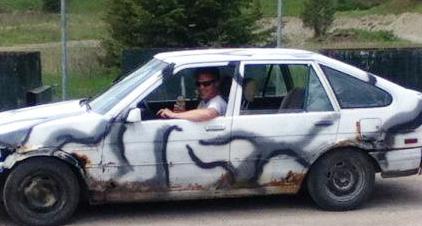
The Bean has been a part of our family for many years, has clocked 200,000 miles, and has been repainted six times from a can, with a brush. (“The Bean,” June 26, 2010) Because this tiny car has become a legend in 9 states, admirers have occasionally helped finance its needs. One generous friend from Texas actually bought 4 new tires a couple of years ago, more than doubling the value of the car. (Thank you, Debbie!)

This week, though, all of us got a shock. When Nelson arrived home from 10 months in a Youth With A Mission Bible school in Montana, he pulled into the driveway in (gasp) a minivan! When we waved goodbye last September, he was driving The Bean. It was wearing a new coat of snow-camouflage appropriate to Montana’s snowy climate, ready to climb mountains with its new tires. (“Back, and Better than Ever,” July 14, 2011)

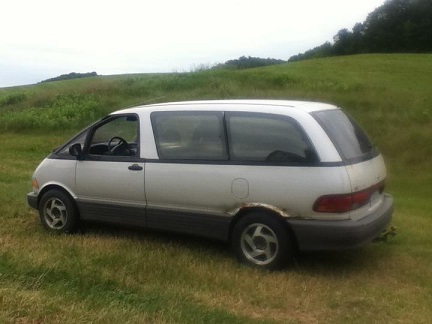
Then, during the school year as Nelson and 50 others studied the Bible from cover to cover in mind-boggling depth, The Bean performed faithfully, transporting students, making airport runs, being the reliable ride it had always been. But more and more its small size became a hindrance. So as license and registration expired, an inexpensive van took its place. The Bean had earned a rest.

This week, though, there’s been mourning in the family camp. Will we ever see The Bean again? “Why didn’t you bring it home?” we all asked Nelson, but of course none of us volunteered to finance new license and registration or pay to update several mechanical issues. In other words, if we really wanted The Bean to come home, we should have put our money where our mouths were.

Scripture says something similar, that we’re to be doers of the Word and not hearers only. We can listen to everything the Bible teaches and nod in agreement, but if we’re not acting on its principles, maybe Scripture’s truth has gone in one ear and other the other. After we hear it, God watches closely, hoping we’ll do something practical with what we’ve learned.

Of course it would be easier to study the Bible and then just keep it to ourselves. I’m a pro at that: “Thank you, Father, for such wonderful knowledge.” But if I take it in and lock it up, I’ve missed God’s intention.

When Nelson’s school ended last week, the staff told all the students, “You’ve worked hard these 10 months and learned a great deal, but God didn’t bring you here to stockpile knowledge so you could keep it to yourself. He wants you to do something with it.”

That’s what’s motivated Nelson (and others) to plan on returning to Montana in September for “The Titus Project,” an outreach focused on teaching them how to be teachers of others. And maybe when Nelson gets there, he’ll even be picked up at the airport by someone driving The Bean.

“Be doers of the word, and not hearers only.” (James 1:22)