
The Gift of Sleep

During the night God gave me a gift – ten hours of sleep. I can’t remember ever sleeping like that, although as a teen I surely must have.

Yesterday had been strewn with melt-downs and tear-ups, and one thing I’ve learned during the eight months since Nate died is that grieving is exhausting. Although I didn’t expend much physical energy yesterday, by the time I crawled into bed, I was whipped.

Before Nate died, I had no idea about this part of new widowhood, but now I’m getting an education. Years ago I asked a recently widowed friend if she wanted to come for lunch, just her and me. I knew enough not to invite a crowd but had no understanding of how hard she was struggling to cope. Without even pausing to consider my offer, she said, “Oh, I couldn’t possibly. I don’t have the energy.”

Her response took me by surprise. I’d planned a simple lunch, assuming talking with someone who cared about her would be encouraging, maybe even strengthening. I had no knowledge of the drain it would be for her to get ready, drive to my house, answer my questions and struggle to maintain composure throughout her visit. Now, because I’ve been on the flip side of that situation, my friend’s rejection of the lunch makes complete sense.

The process of grieving a loved one is strenuous, and losing a spouse is wrenching. Although I’ve seen both of my parents pass away and experienced deep sadness both times, grieving for Nate is in a separate category. When people get married, they “leave and cleave,” which is biblically correct and should set parents down a peg on the priority list. After marriage, a husband trumps mom and dad.

As the years and decades of marriage compile, the marital bond strengthens, or at least that’s the way it should be. Though we’ve known our parents longer than our mates, the parental bond doesn’t have the power of two-becoming-one.

Mary asked me yesterday if I missed Nate more than I expected I would. The answer? Definitely. It seems there’s no end to my discovery of the ways he was dear to me. We were undeniably two halves of a whole, but when he was with me, I didn’t give much thought to that idea. Now that he’s gone, it’s painfully evident. And when half of anything is removed, the other half falls.

Since none of us can “walk in another’s moccasins” until our experiences overlap, we can’t appreciate someone else’s response to a life crisis, just as I couldn’t comprehend why my friend didn’t want to come for lunch. But as we live through our own experiences, we gain understanding. The gains come with pain, but they eventually become the way we can help others. Maybe that’s why my Widow Warriors are so precious to me and have blessed me profoundly. They’ve already walked the road I’m on, which validates their counsel. And many of them have advised me to “get good rest.”

After last night’s sweet sleep, which was God’s timely gift, today has been a much better day.

“This is what the Lord of Heaven’s Armies, the God of Israel, says: I have given rest to the weary and joy to the sorrowing.’ At this, I woke up and looked around. My sleep had been very sweet.” (Jeremiah 31:23,25-26)
Meltdown

I knew I shouldn’t have done it. After all, it was a Sunday.

*        *        *        *        *        *        *        *        *

I’d been by myself at the house this morning, unusual for a Sunday, and even though I was up and ready, it crossed my mind to skip church. No one would miss me, and I wouldn’t have to sit alone. But that sounded like going backwards, so I drank the last of my coffee and headed out. Despite wearing a skirt, I rode my bike rather than walk the six blocks, because I was late.

As I pedaled toward the church, I could hear a woman’s voice being piped from the pulpit to outdoor speakers. She was weeping as she asked for prayer to handle a challenge she was facing. Parking my bike near an out-of-the-way bush, I felt ashamed of my self-centeredness, having temporarily forgotten that no one is immune from serious pain.

By the end of the service, I felt weepy and headed away quickly, talking to no one, anxious to get back to the shelter of the cottage. Although our family tradition has always been to eat out on Sundays, a bowl of oatmeal sounded just right. But I should have known better than to accompany it with the hard-copy stack of emails from the early days of Nate’s cancer.

This stack of 8 X 11 papers, which I’ve tried to read several times,  approaches the sacred to me, and a sad Sunday seemed like the right time to read a few more. I was missing Nate, and by looking back into those days when he was still alive, it was almost like a visit with him.

The 50-plus emails in my stack were all dated between Sept. 23, the day after Nate’s diagnosis, and Sept. 29 – six days of shock and hurt. When the girls had printed them out at my request, some of my own responses were still attached to many of them. It was one of my own paragraphs that made me burst into tears over my oatmeal. The following lines were written to Linnea on Sept. 24, two days into Nate’s cancer:

“Tonight as we were driving home from Chicago (me driving), Papa was beginning to share something about our family, but when he said the phrase ‘Remember when the kids were little and…’ he broke down and wept. I don’t know what it was, but I think he was thinking back to those happy days and one of you doing or saying something cute, and thinking of these difficult days now and the passing of time, and all of it mixed in together for him.”

Dabbing at my mascara, I set the stack of emails aside once again, wondering if I’d ever be able to get through them. I want so badly to re-read what our precious friends and relatives had sent in the beginning, knowing their words and verses had been chosen with care to encourage and support. They might hold even more power now.

All of a sudden I had an overpowering urge to look at Nate’s wedding ring. I ran upstairs and pulled the tiny green velvet bag from my dresser drawer and took out his gold band, hugging it and crying with longing for my man. It’s not easy when the only thing left to hug is a husband’s cold ring.

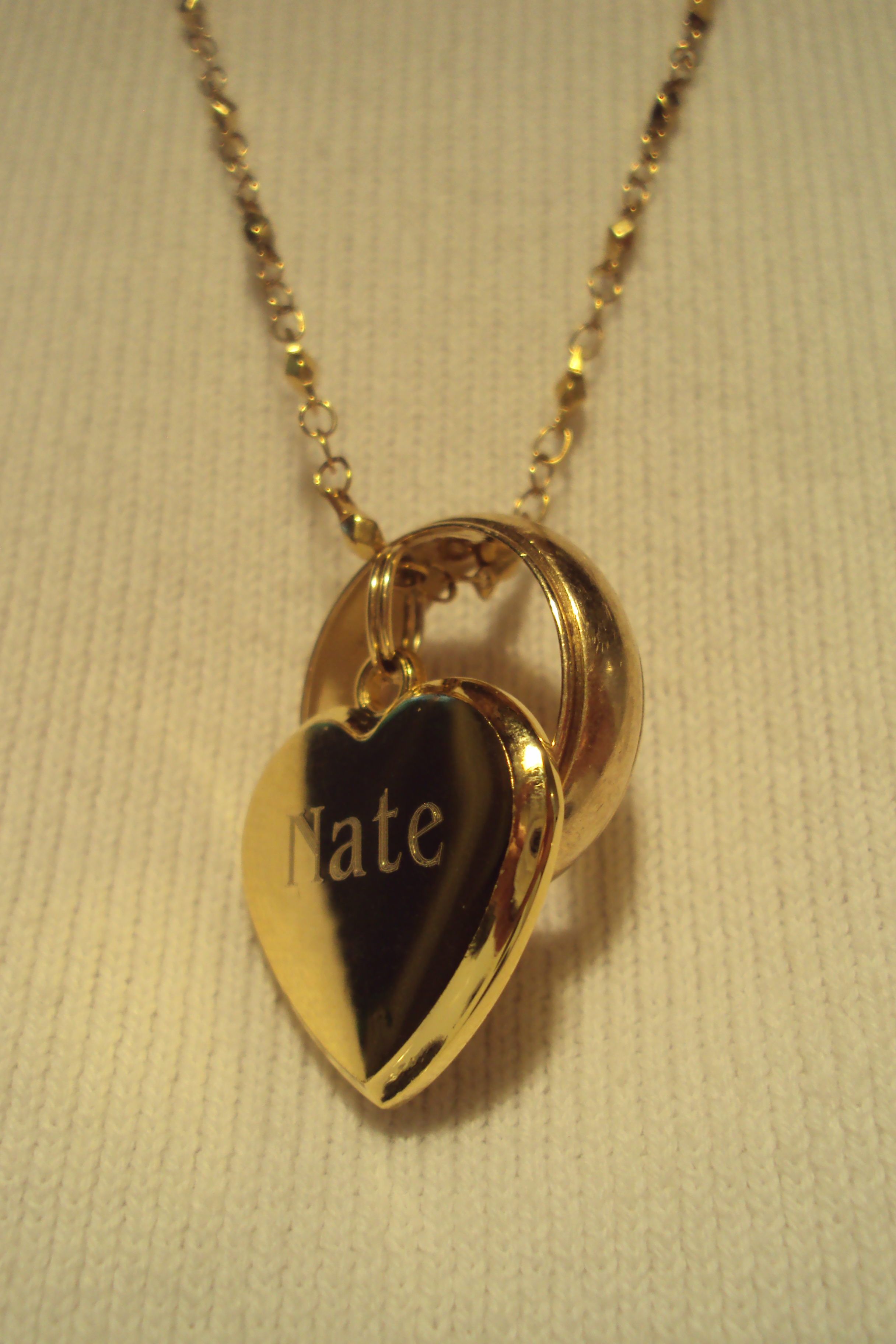
I took a gold chain off its hook, the one with the heart pendant that had Nate’s name engraved on it, and slipped his ring onto the same chain. Suddenly I couldn’t make sense of what seemed like a contradiction: God is good, but this is bad. Although I’ve accepted his goodness many times over in recent months, today it wouldn’t compute.

Immediately a favorite quote came to mind, and I knew right away Who was rushing toward me with understanding and comfort:

“If you can explain what God is doing, God is probably not doing it.” (Dr. Bob Cook)

In other words, because I can’t explain Nate’s cancer, his death and our grieving, I can be certain the whole thing IS of God, and I know he wouldn’t have taken Nate as he did without an excellent reason. God doesn’t expect me to understand his ways. (Both he and I know I never could.) He only asks me to believe he knows best… for Nate… and for me.

And I do.

“ ‘My thoughts are nothing like your thoughts,’ says the Lord. ‘And my ways are far beyond anything you could imagine. For just as the heavens are higher than the earth, so my ways are higher than your ways and my thoughts higher than your thoughts.’ ” (Isaiah 55:8-9)

Learning Curve

From the time I was a toddler, prayer was in my life. It started with poem-prayers from a child’s Golden Book, repeated in a sing-songy way I could repeat along with Mommy. I learned there was an invisible someone to whom she talked in a special way, with her hands clasped and her head down, someone who listened to her. Whoever he was, he commanded great respect from grown-ups.

During my school years, Mom would kneel next to the bed and pray individually with each of us, one at a time, teaching me by example to approach prayer with humility and care. The poetry was left behind, and Mom’s praying became personal to our family situation. I concluded God must know who we were, each one of us.

When I was in 8th grade, life got complicated. My cousin Karen was killed in an accident that year, and my parents evidenced distress like never before. When no one knew what to do, Dad quietly said, “We need to pray.” And as he put words to our anguish, I learned that during the worst of times, prayer helped.

Mom continued praying with us through the high school years. By this time her calls to heaven on my behalf numbered in the thousands, but one specific prayer stood out. Mom was praying for a godly man to one day be my husband. Then she prayed, “And Lord, if any man ever breaks her heart, I’ll break his neck.” I opened my eyes and looked at her, but she was sincere. I was learning that prayer was a way to entrust God with my future, especially if I was nervous about it.

When I went off to Wheaton College, I was forced to decide where I really stood on religion and whether or not the God to whom I’d been praying was important to me. Although I lined up with those who were committed to him, privately I set prayer aside.

But then I married, had children and needed God badly. I came under his leadership in a new way because I was responsible for the welfare of another human being and was inadequate to the task. Prayer became my link to God’s wisdom. I learned that prayer was a two-way conversation, not just me asking but him offering back to me.

Small groups, prayer meetings and increased needs for guidance from a trustworthy source served over the years to develop a strong bond between God and me, and I learned that prayer was instrumental in deepening our relationship. And best of all, he began to identify his answers.

Eventually I decided to pray less of my words and more of his, which led to praying Scripture over people. I set my “wish lists” aside and prayed for the things I knew God wanted: humility, a pure heart, goodness, increased faith, conviction of sin, patience. I learned God isn’t concerned about our having a good time but wants to develop our character, and prayer is a good starting place.

Now prayer is on my mind continually. If a day ends without a chunk of time spent in conversation with God, I go to bed with a sense of loss. I want to get as close as possible to the amazing Person who hears and answers prayer. And the best way to do that is to converse with him.

God has made himself available, and I’ll spend the rest of my life taking advantage of this priceless offer.

”Pray in the Spirit on all occasions with all kinds of prayers and requests.” (Ephesians 6:18a)