
Return to Sender

Each day as I gather my clipboard, pen, Bible and devotional book to have a conversation with God, I do something fun. I pick a card from my basket of mailed greetings as the “card of the day.” These are the messages people sent when Nate was ill, continuing after he died. Some are store-bought, some hand-made and some are regular letters. But the point of doing it is to make that person or family the subject of prayer.

I’ve grown to love this process, and although it seems I choose a card at random, I believe that as my hand hovers over the basket of several hundred greetings, God actually does the picking. He is thinking of specific people who need prayer exactly on that day, and those are the names on the card “I” pull.

As I re-read the card or letter someone sent last fall or winter, the words are a brand new blessing to me. But here’s the cool part. The sender’s own words become a springboard of prayer right back to them. In other words, the messages and Scripture verses they took the trouble to send to us are sent back to them by way of God’s throne room, returning to the sender with a fresh burst of supernatural power in the way of answered prayer.

At the end of that day’s prayer time, the card goes into a second basket. Once the first basket is empty (maybe by the end of this year), I’ll start all over, drawing each of the greetings again.

This is what I call a good time in prayer, and of course anyone can do it. In addition to being a little surprise package each day, it’s a surefire way not to forget anyone. I can’t explain how much I’ve enjoyed pulling the “card of the day.” And as I’ve studied just one each morning, thinking about what the sender(s) first wrote many months ago, I’ve been newly appreciative of every correspondent and each “good word.”

Today God chose a beautiful lavender card that came all the way from England. Hans’ wife Katy’s grandparents, Anne and Ken Mills, sent me a sympathy card shortly after Nate died. The words on the card, some printed and some hand-written, touched on these subjects: God’s peace, God’s promises, life everlasting, being released from suffering, going to be with Jesus after death, caring sympathetic people, hope in the Lord and reassurance of love. It was my delight to pray each of these topics over Anne and Ken today, a “return to sender” type of prayer.

God never fails to do abundantly more than we ask in prayer, and I believe he answers every request. This is even better than a 401K that receives matching funds by an employer.

And with such spectacular work on God’s part, I don’t want to miss picking a single card!

“[I] give thanks to God and the Father of our Lord Jesus Christ, praying always for you.” (Colossians 1:3)

New Widow Friends

Although Nate and I were fans of public TV when we lived in the Chicago area, here in Michigan I’ve become a devotee of public radio instead. That’s a result of not being able to receive a television broadcast signal, along with being stubborn enough not to get cable. Whatever the reason, I’m thankful for NPR.

Today I listened to an interview of two widows who had both written about their experiences, one having been alone four years, the other 18 months. The show was entitled “The Daily Challenges Of Learning To Be A Widow.”

I knew the program was coming and had structured my day to listen, readying a pile of ironing beforehand. The minute these two ladies came on the air, although both were strangers to me, I felt an immediate kinship. Other widows called in with questions and comments, and my heart bonded with each one.

For example, one asked about wedding rings, how to know when it was time to take them off. The two writers gave opposite answers. One said she hadn’t taken them off yet and had actually begun wearing her husband’s ring, too. The other said she’d taken her rings off only one month after her husband’s death, because she wanted to look at her hand and be reminded of what had happened, rather than forget even for one instant.

These widows also discussed the question, “What is my new place in life?” The answers vary and only come with a great deal of introspective work and the painful passing of time. Unlike in a divorce, marriage had been most widows’ happy place to be.

They also tackled the question, “How much do I rearrange my life and how soon?” One call-in widow had to move out of her home immediately, because she kept thinking her husband might walk through the door he’d walked through so many times before. Of course she knew he wouldn’t, but the pain of forgetting then remembering was a roller coaster she chose not to ride.

Many widows have email addresses with their husband’s name in them. They have to ask, “Is it more helpful to delete his name or leave it as a comforting reminder of him?”

A younger widow talked of the stress of raising children alone. While that was being discussed, an older widow pointed out that having children, though taxing, forces a widow to stay in the mainstream, eating regular meals, structuring sleep and wake times, and attending happy childhood functions. An older widow often loses interest in cooking just to eat alone, and she might start keeping crazy hours.

At the conclusion of the program I felt better than I had at the start. It was encouraging to know women all over the world (245 million of them) are trying to build new lives without their mates, just like I am. And because the first Baby Boomers are moving through their sixties, there will be many more.

Although none of us widows have identical fact-sheets, our responses to widowhood are often shared. I’m sure there were sympathetic head-nods at the end of every radio wave today. And without even meeting each other, we became friends.

“The Lord your God is God of gods and Lord of lords, the great God, mighty and awesome… He defends the cause of the fatherless and the widow.” (Deuteronomy 10:17,18)

I think I can. I think I can.

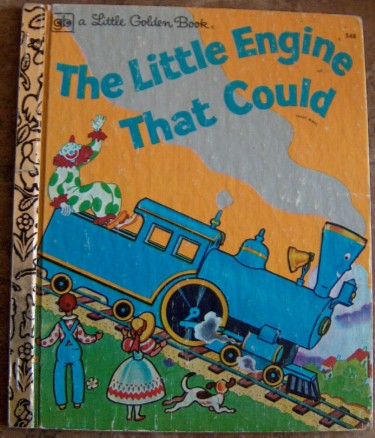
Most of us remember an inspiring childrens book entitled “The Little Engine that Could.” It championed the attribute of stick-to-itiveness, even when the odds were formidable, such as having to climb over a mountain while pulling a heavy load.

Although the first published version of this story was part of a Sunday school paper in 1906, at least four authors are on record as having written it. But way back in the first part of the Old Testament, God had already authored the tale, and not just authored it but also offered to fortify our can-do effort with the strength to get a difficult job done.

In a Deuteronomy passage, Moses, the revered leader of several million people over 40 year’s time, had died just short of entering their new homeland. In these verses the people were recounting specific blessings he’d spoken to each of the 12 tribes before he passed away. He knew battles were coming and had done his best to encourage and prepare them, confident that  God’s abilities exceeded those of every enemy.

Last fall, as Nate’s health made its rapid plunge toward complete incapacitation and finally death, I was fearful I wouldn’t be able to handle the unknown “mountains” ahead in caring for him. I’d heard stories of uncontrollable pain, abusive words coming from patients, horrible bathroom messes and frightening death scenes. Would I make it?

Then I opened a letter from our friend Caroline in England. Although her words of love and kindness meant a great deal, the real power was in the few words of Scripture she’d written next to her signature. They reminded me of the little blue engine who eagerly wanted to succeed, even after others had failed, others who were better suited for the job than he was.

I felt ill-suited for my job, too, but I wanted to succeed, to be everything Nate needed me to be, no matter how distasteful, agonizing or sad it became. And most of all I wanted to remain single-minded to the very end, putting Nate ahead of everything else. But I had no idea how I would have the know-how or strength to conquer whatever might come.

But amazingly, as each day passed, the Lord supplied whatever was needed, enabling me to say, “I think I can. I think I can.” God astounded us again and again with his creative provisions, never running out of new ways to come to our aid. And there isn’t any set of crisis-circumstances God can’t handle. He is the enabler; we are the I-think-I-cans.

At the end of the story of “The Little Engine that Could,” the blue train slides with ease and joy along the track on the down-side of the mountain, having done what the other engines thought was impossible. Smiling at his accomplishment, he says, “I thought I could. I thought I could.”

And that’s where our storyline breaks from that of the blue engine. Although we, too, look back with amazement, we’re looking at God’s accomplishments, not our own. It’s “We knew God could. We knew God would.”

“As your days, so shall your strength be. The eternal God drives out the enemy before you.” (Deuteronomy 33:25b,27b)