
Be prepared.

I loved being a Girl Scout. Our motto was: “Be prepared.” This meant we were always to be mentally and bodily ready to face difficulties or even danger by knowing what to do and when to do it.
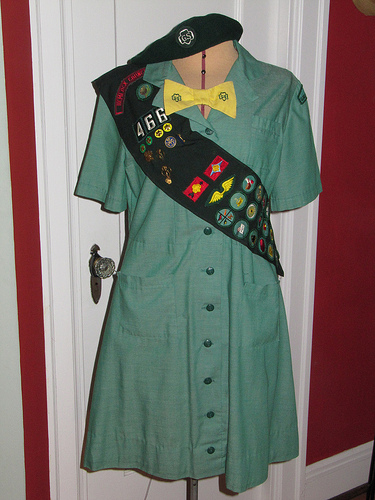
In an effort to get properly prepared, our leaders encouraged us to earn badges to prove how prepared we actually were. They taught us to make a fire, understand food nutrition, know about leadership, learn water safety, and much more.

As we earned our badges, we accumulated knowledge, and in order to apply it, our leaders role-played with us, testing our responses to different hypotheticals. They figured if we practiced enough, when a moment of need arose, we’d automatically jump in to help in appropriate ways.

Role-playing is a practical way to learn, and most of us do it eagerly. For example, before a couple gets married, they often attend counseling together. The pastor or teacher describes marriage moments they’re bound to encounter and asks how each would respond. The resulting discussions point out potential problems.

Nate and I did plenty of role-playing as we prepared for marriage: “What if we don’t have children? What if we do? If we move away from family, how will we handle that?” We worked to trouble-shoot, hoping we wouldn’t have too many bumps in the adjustment road, once we were married. It was all part of getting prepared.

At the other end of our marriage, as empty nesters heading toward retirement, we role-played once again: “When is it best to retire? Then what? And should we move? If so, what’ll happen when our children and grandchildren visit? And will our money last through old age? Should we travel before we get too old?” We wanted to be prepared.

The thing we didn’t role-play was an “early” death for one of us. “What will your/my life look like, if you/I should die? How can we prepare for that?” Other than life insurance, we hadn’t even discussed it.

Subsequently, when we learned of Nate’s cancer, we huffed and puffed trying to prepare, but death caught up to us before we were ready. When it was all over and I was alone, I stood in my living room on a wintry night and thought, “Now what? I’m completely unprepared for this.”

But God, who’s always ready for everything, had a good answer. “Since you couldn’t prepare for what was coming next, I did it for you.”

And here’s what he’d prepared:

  1. my grieving process
  2. this blog to tend
  3. a book to write
  4. Birgitta and her baby to help

In hindsight I can see he had me ready, so I’m not going to worry about what numbers 5 or 6 will be. And if I’ve learned anything in the last few years, it’s that living within God’s preparedness is a better place to be than role-playing the unknown, all by myself.

 “I cry out to God Most High, to God who will fulfill his purpose for me.” (Psalm 57:2)
Accepting Widowhood

As of today, I’ve been a widow for 2½ years, though it feels like it’s been much longer than that, maybe a decade longer. Most widows agree. That might be because of all the tears cried or maybe just the many radical life changes. It could simply be the fatiguing nature of deep grief. Whatever the reason for feeling like a long-term widow, I can still identify quite a few positives coming out of those same 2½ years.

Widowhood was God’s choice for me in exactly the way and time it came. I can view it as a crisis sent from him or the result of living in a fallen world. Or I can take a completely different approach and see it as the reason I expanded my dependency on the Lord to a depth I would never have known without becoming a widow.

Women with husbands have this same opportunity to lean hard on God day to day, hour to hour, but taking advantage of it isn’t the driving force it is for a widow. When widowhood hits, extreme neediness forces a quest to find a new system of support and guidance.

Some women hold back, mad at God for taking their men. Others try to go on “as always,” but of course that doesn’t work. The Lord patiently stands at-the-ready, waiting with open arms and unlimited resources to step into the increased role we need from him.

If we don’t pull in close to him right away, it’s comforting to know he’ll wait until we’re ready. His offer of kindness, strength, and provision is open-ended, for always. The more desperate we become, the greater his rescue.

I’ll always miss Nate. We met when we were both 21, having officially left childhood behind, and were eager to start adulthood together. My entire adult life was spent in partnership with him, and although we had the usual marital disagreements, I’ll never forget the happiness we shared.

Since widowhood, with God’s steady encouragement and provision, the painful parts of our separation are mostly behind me. I can even think through the details of Nate’s cancer, his last hours, and his funeral without crying, which is exactly what other widows told me would eventually happen.

Although I never would have requested widowhood, as I pass the 2½ year mark, my memories are sweet, and the future, though undefined, is not a threat. I’ve found God’s ears open to my cries and his promises spot-on. And I’m confident that what’s been true of him during these past few years will continue to be true into the distant future.

And part of that future will always be to tell the story of how good he’s been to me.

“The widow who is really in need… puts her hope in God and continues night and day to pray and to ask God for help.” (1 Timothy 5:5)

Something to Crow About

Three year old Skylar lives in a country-like neighborhood with lots of natural wildlife, including a flock of crows. Sometimes they swoop around in a group or congregate in one tree. When that happens Skylar says, “Today they’re having a meeting.”

Recently a crow flew overhead with a “Caw! Caw!”

“Wow!” I said. “Did you see that giant black bird?”

“That’s a macaw,” she said.

“Really?” I said, watching the crow disappear over the trees. “I thought macaws had bright colors.”

“No. They’re black.”

Then she said, “And I speak their language.”

“Impressive,” I said. “How’d you learn that?”

“Oh, I always knew it,” she said. “Actually, I taught it to the macaws.”

Learning languages is tricky. Teaching them is more so. Most of us have struggled to learn the ins and outs of a foreign language during school years, from Latin to French to Spanish and beyond. Biblical scholars work at Hebrew and Greek, and toddlers work to be understood by anyone.

Gary Chapman wrote THE 5 LOVE LANGUAGES, explaining how to communicate best with those we love most. Not only do different generations speak differently, different decades do, too. But that’s not all. There are male-female variations and personality-type distinctions. It’s almost too complicated to figure out, so why bother?

We bother because of love.

When we love someone, we want to understand them better, including foreigners. Despite not understanding at first, it’s good to keep trying. God, the Great Communicator, is hoping we will. His desire is that we all become members of his family, and part of having harmonious relationships is communicating effectively. If we can’t understand each other, we are, in a way, foreigners living together in frustration. The Lord wants us all to “click,” and like all good fathers, he’s hoping his children will get to the place of communicating blessing to each other.

He also wants us to come to him for conversation. The biblical David put it well: “My heart has heard you say, “Come and talk with me.” And my heart responds, “Lord, I am coming.” (Psalm 27:8) I’ll never get over the fact that God Almighty has an interest in our communication with each other, and even personally, him with me. My longing is to talk to others and to him in a way that will please him, and to accurately understand his language back to me.

And so I’ll keep trying.

I’m also trying to communicate with the crow-macaws as well as Skylar does. Yesterday we were playing in her driveway when she said, “I can ride my bike as fast as the birds fly. And when I yell up to ’em in bird language, they fly where I tell ’em to go.”

Flawless communication, to be sure.

”There are many different languages in the world, and every language has meaning. But if I don’t understand a language, I will be a foreigner to someone who speaks it, and the one who speaks it will be a foreigner to me.” (1 Corinthians 14:10-11)