
It rocks!

The desk where I sit and write becomes messy quickly and needs frequent de-cluttering. Even when I’ve filed all the papers, put the pens and glasses away and removed the dirty dishes, there’s one item that always stays: my Scripture rocks.
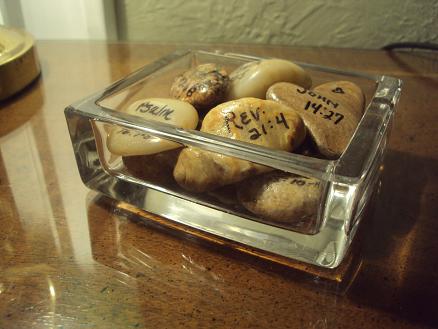
When Nate and I first heard that his cancer would take his life, we resisted accepting what we’d been told. I remember the morning after his diagnosis. My sister Mary had rushed from the Chicago area to Michigan to do what she could, and that next morning I found a beach stone sitting atop my kitchen counter with her writing on it.

It was a Scripture passage meant to encourage both Nate and I, which it did. (See “A Rocky Road,” October 10, 2009.) Two days later I found another rock, and over the next few weeks, nine more, always when we needed them most.

In addition to the Bible verses on each one, the stones were a continual reminder that our lives were built on the solid Rock, Jesus Christ. It helped to know when life became unstable, that this firm foundation would never be shaken.

Earlier this week in Christchurch, New Zealand, everyone and everything was badly shaken by a major earthquake. Buildings collapsed. People were injured or killed. Hundreds have not been found.

Our son Nelson and other leaders at the Youth With A Mission base nearby heard the ominous rumbling immediately before the ground began shaking, most experiencing their first quake. No one at the base was hurt, and they quickly sent representatives to Christchurch to help. In coming days, many more opportunities will present themselves, and these leaders, along with the students who begin arriving this weekend, will do what they can.

Most of us walk around thinking we have a measure of control over our lives. In reality, it doesn’t take more than a few seconds to shake us badly, either physically (an earthquake) or emotionally (cancer). Both can come without warning. Both can snuff out lives. What, then, is unshakeable?

My Scripture rocks.

The words they represent have the power to remain standing through natural disasters, diseases and everything in between. From those verses, come some unshakeable guarantees: the Lord is a stronghold in times of trouble, a firm place to stand, my refuge, a strong tower, a Rock eternal; he wipes away my tears, restores my soul, puts a song in my mouth; he’ll never forsake me, will set me on a high rock, will not allow me to be shaken.

But we were shaken by Nate’s cancer, and the citizens of Christchurch were shaken by the earthquake. So are these verses lying? No. They’re describing truth that applies to our hearts, souls and minds, the real us. As Nate discovered during his last days, everything was taken from him except one thing: the Lord. Earthquake victims learned that same reality this week, and eventually we’ll all experience it.

This truth makes us tremble until we look at what Jesus said on Mary’s heart-shaped rock:
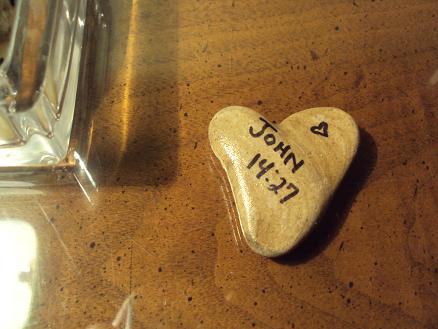
“Peace I leave with you; my peace I give you. I do not give to you as the world gives. Do not let your hearts be troubled, and do not be afraid.” (John 14:27)

Same facts. Two perspectives.

Last night when Jack and I took our late-night walk, he threw himself into the fresh snowdrifts with his feet in the air six different times, reveling in the doggie-joy of making snow angels. He made six angels in eight blocks, a lot of happy dancing, even for him.

I hadn’t dressed warmly enough and was counting the steps till we got home. By the time we reached our driveway, I was shivering but did my own happy dance while opening the back door. Jack, however, was disappointed the walk was over and planted himself at the street-end of the driveway as if to say, “I wanna stay out and play!” Same facts. Two perspectives.

I often think of Nate in this regard. Although he trembled when he first heard something serious might be wrong, after accepting the terminal diagnosis, he became peaceful. For me it was just the opposite. When I heard “pancreatic cancer,” I stayed strong and was able to encourage Nate. But after he accepted that he would die, I broke down often, aghast at that prospect. Same facts. Two perspectives.

I have a choice to look at my “destiny” as Nate’s wife from two perspectives, too. I can dwell on the negatives brought by his death, or I can view widowhood as my calling. Depending on which of those two viewfinders I’m looking through, I can either self-talk a poor-me mentality, or count my blessings.

Many widows would reject the idea that widowhood is a calling. We think of a calling as something special like being called to missions, teaching or the pastorate. It hints at unique giftings and fulfillment in using them. People are called to singlehood, marriage, motherhood. But widowhood?

The word widow conjures up thoughts of a black widow spider, along with the words toxic, venomous, lethal. Books and movies with the word widow in their titles are dark comedies or scary dramas. At best we think of widows as lonely, disadvantaged and needy. Can it be a calling?

I believe it is. Because I’ve committed my life to God’s leadership, I regularly ask him to superimpose his plans over mine. I tell him I’m willing to go through whatever he decides is best to teach me what he wants me to learn. I know my earthly life is preparation for my eternal life, and I’m aware of the many rough edges he needs to eliminate to get me ready. If coping with widowhood is his way to accomplish that, then being a widow is what I want.

As extreme as that sounds, it jives with Scripture: “God works for the good of those who love him, who have been called according to his purpose.” I’ve been called according to his purpose, and his purpose for these days is widowhood. But lest I despair, the verse also says God is working for my good, within my widowhood-calling. And when he offers to work in my life in any capacity, I’m for it!

Same facts. Same perspective.

“We know that in all things God works for the good of those who love him, who have been called according to his purpose. If God is for us, who can be against us?” (Romans 8:28,31b)

Poor Job

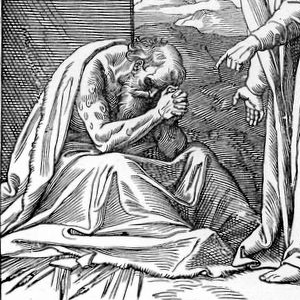
Today our ladies Bible study began a new book: Job. The first chapter leaves us breathless watching four of Job’s servants delivering nonstop bad news. In seven verses we learn that this exceedingly wealthy man has lost 11,000 farm animals, all but four of his many employees, and his ten precious children. Later in the story he also loses his health.

Interestingly, as today’s Bible study leader began, she first updated us on the health of two hospitalized men from the congregation. Both were not doing as well as expected, and our group was disappointed by the news.

Part way through our morning, the other pastor arrived to say one of these men had taken a turn for the worse, his family being summoned to say goodbye. We talked of the two wives who were suffering also, and the woman sitting behind me whispered, “It’s too much.” Suddenly we felt the relevance of the Book of Job.

We’re learning that the same calamities Job experienced 3000 years ago still happen today: losses of family, wealth, possessions, business and health.

Why does God let/ask people to suffer? Today our group talked about the reasons in relation to Job. Maybe his relationship with God was strong only because his life was bursting with blessings. Removing those would test him.

Maybe God wanted to increase Job’s trust in him by letting him discover that when you have nothing, you still have God. Maybe he wanted to deepen Job’s faith by allowing Job to show himself how he’d weather a storm. Or maybe Job’s story is simply a teaching example for the rest of us. As we look at his life we think, “Job made it, so I think I can, too.”

Those may be valuable reasons for his suffering back then, but knowing them doesn’t lighten our loads now. When my husband got cancer and died, it was the worst thing that ever happened to me. But who’s to say my suffering is over?

Our world is broken. The last time it wasn’t “out of order” was in the Garden of Eden. I’ll bet there was no suffering there. Although Adam and Eve were people much like us, until they sinned against God, their lives were without struggle or sorrow. Their world was all “good”. God even said so.

Our world isn’t so good.

I’m steeling myself for what I think we’ll learn from Job, that more suffering is coming for me and all of us. Until we leave this earth as Nate did, through death’s door into a God-created, “good” paradise, we’ll be challenged with losses of family, wealth, possessions, business and health.

The miracle for each of us is that we’re not suffering on a continual basis. Although God allows losses, he also provides periods of non-suffering, times for recuperation and strengthening before the next challenge. I think Job will teach us that when things are going well, life hasn’t “gotten back to normal.” Our real “normal” is to do battle with adversity.

But if Job can make it with his faith in tact, so can we.

“Though he slay me, yet will I trust in him.” (Job 13:15a)