Letting Go, Part I

Any mother who loves being a mom faces a bit of angst when it comes time to let her children go. The first really big “go” is off to college, a tough goodbye for most parents. But it helps to recognize we’ve been letting go in small ways during the 18 years leading up to that, each one a bit of training for the bigger go-moments.

The first small one is letting go of breastfeeding, followed soon by babies who grow into toddlers and prefer being on their own feet to being perched on our hips. Little by little they go – to the church nursery, preschool, kindergarten, summer camp. We find ourselves on the outside looking in, checking our little ones through one-way glass. They’ve gone into the room; we’re out in the hall.

Even as we clap for every new accomplishment, inside we’re struggling to keep a smidgen of sadness at bay. As time passes, our children go farther and farther from us, the natural order of things.

During the early years of letting-go’s, if our young ones object to being away from us, if they cry when we leave them, we get upset. But if they don’t mind going, that upsets us, too. Like it or not, each mini-going is a stepping stone to the biggest ones: moving into first apartments, getting married, relocating out-of-state, possibly out of the country.

Tonight I watched Birgitta go again. Because she’s having a good year at the University of Iowa, and because she’s had many “go’s” before today, our farewell wasn’t strained. Still, watching her drive away pushed me immediately into prayers of concern.

Last time she made this same drive (after Christmas break), a sudden snowstorm iced the roads till they became treacherous, and half way back to school she had a harrowing experience. Deep slush on the highway left only tire-track ruts to guide drivers, and visibility was poor. Her car fishtailed then began to swerve, ending in a full-circle spin. She came to a stop at the edge of the shoulder, other cars flying past her.

Incredibly, no one was hurt and no damage occurred. After taking a few minutes to collect herself, Birgitta cautiously finished her drive.

Today, as we looked out the window, the weather looked fine. But just to reassure her (and me), I said, “Let’s check weather.com before you go.”

The hour-by-hour chart showed a deteriorating forecast with the highlighted word “icy” in two of her five driving hours. Temperatures were exactly 32 degrees, that mysterious place of maybe-slippery-maybe-not. When we saw this, both of us sucked in air simultaneously like an unplanned duet. But she had to go anyway.

As she drove away, praying was the only way I could help. As I talked to God, he talked right back and said, “I know you’re thinking about Birgitta’s snowy spin-out. Some day I’ll explain exactly how I was involved in that, but for now, just know I was involved. You’re watching her go and you’re feeling helpless, but remember, I’m not just watching her, and I’m never helpless. Where she goes, I go.”

“You [Lord] are my hiding place; you will protect me from trouble and surround me with songs of deliverance.” (Psalm 32:7)

Will I be sorry?

I take the Bible literally, and the verse that says “every knee will bow to the Lord” is, I believe, self-explanatory. God emphasizes it by including it in both the Old and New Testaments.

Even though I’m looking forward to visually connecting with Jesus, a mental picture of the bowing moment gives me pause. I already know what I’ll be thinking: “I wasted so much time on unimportant stuff!”

I wish I could head off that part of it, and maybe I can. The trick is to stop wasting time. If I can accurately define what that is, maybe I can fix things before I get there.

As a child I had to memorize John 15:7 in the King James Version: “If ye abide in me, and my words abide in you, ye shall ask what ye will, and it shall be done unto you.” It was a verse full of mystery because of my limited understanding of the word “abide” and also because it said I could ask God for anything and get it!

In studying John 15 during the years since childhood, I’m beginning to understand. Jesus was probably saying, “Becoming close friends with me will be your key to happiness.” He even uses the word “friend” three times (about us!) in the next few verses. And what do good friends like to do? Spend time with each other, talk to each other, love each other.

Over the years I’ve also seen that the asking-and-getting part of that verse is totally dependent on the abiding part. After we become close friends with Jesus, our requests will differ radically from those a child would ask.

If I want to do my personal best when kneeling time comes, I need to work now on my friendship with Jesus by carving out time to be together developing our friendship. That includes listening to the words he’s already said (Scripture) and responding back with my own (prayer).

Thankfully, he “gets” the necessity of human to-do lists. But he also lets us know that abiding in him while going about our business is important. He even says, “Apart from me, you can do nothing.” I think he means “at least nothing important, nothing you’ll be happy about when you’re kneeling in front of me.” We can do plenty of things “apart from him,” things he doesn’t sanction, and most of them will get us in trouble. But to accomplish the high-road stuff, we need to abide in him.

Every day I think about Nate and our radically different life-settings. Has he already experienced the kneeling moment described in Scripture? Or will we all be doing that together at the end of time? More importantly, has he been allowed the inconceivable freedom of moving past the inadequacies of that moment? Has he moved into face-to-face friendship with Jesus, uninhibited by human limitations?

It may be quite a while before I get the answers to all these question marks, but I know I will. In the mean time, my interest is in what will come before those answers: my moment to kneel.

“As I live, says the Lord, every knee shall bow to me…” (Romans 14:11 and Isaiah 45:23)

Lookin’ Good!

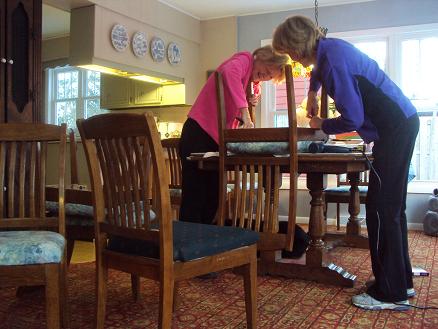
This afternoon Mary and I talked about “the ravages of time” on our old faces and the magic of plastic surgery. Not that we’d do it, even though the mirror says we should. (It’s easier just to avoid the mirrors.) But this afternoon we did get involved in a face lift of a different sort. The two of us put fresh upholstery on eight dining room chairs, a simple way to “lift” a room.

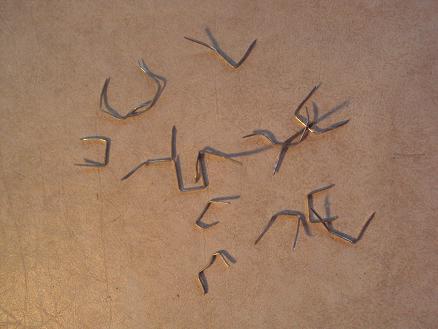
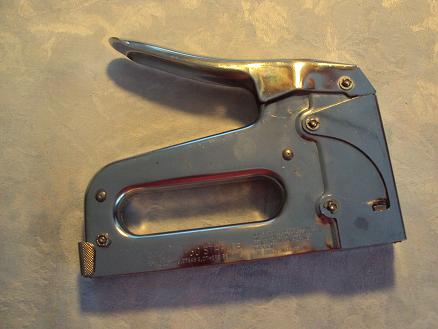
To be successful, however, requires the right tools. Factory-tightened screws can be difficult to loosen, and succeeding assumes you’ve got the right screwdriver. You also need a staple gun, a tool that doubles as a weapon of mass destruction. Keeping a hammer handy is good for staples that don’t go all the way in, and a box of Band-Aids isn’t a bad idea, either.

Doing something new is never easy, and trudging up the learning curve usually includes a measure of slip-backs: our chair corners ended up with too many folds; staples went in loosey-goosey and needed to be yanked out with pliers and redone; stray fabric peeked out from the chair frame, another re-do; one “staple-shot” grazed my finger and drew blood. But each chair we did got a bit easier and ended up looking a little nicer than the one before.

Isn’t that the way with life? When something new comes to us, particularly something we don’t want to do, we look for ways to procrastinate. When we’re finally forced into it, it’s often not as bad as we anticipated and might even become satisfying. Practice may not make perfect, as the saying goes, but working steadily at something does bring improvement.

God often asks us to do new things we don’t want to do, like love an unlovable person, suffer intense pain, surrender a spouse or a child, care for someone who doesn’t appreciate it, or wait “forever” to see our prayers answered. But we can get better at handling each of God’s assignments by simply cooperating with his tutoring, because he’s the great Supplier of know-how in every set of circumstances. As we tackle what he sends to us, practicing as we go, little by little we work out the kinks. Difficulties lessen, and satisfaction begins to peek out at us.

Of course God’s “chores” are far more complicated than fixing up old chairs, but Mary and I learned a few things today, too. When we started out, our confusion, misuse of tools and lack of knowledge caused us to lose 45 minutes on the first chair seat.

We decided we’d work to improve our time on the next one. There were set-backs and continued failures, but each successive cushion taught us better ways to do the same job. The last chair took us only six minutes, start to finish, and that included a staple refill. Now, gathered around the dining room table, our 22 year old chairs don’t show their age at all.

Hey! Maybe Mary and I could use our improved stapling skills to give each other face lifts!

Jesus said, “Blessed are all who hear the word of God and put it into practice.” (Luke 11:28)