Small Beginnings

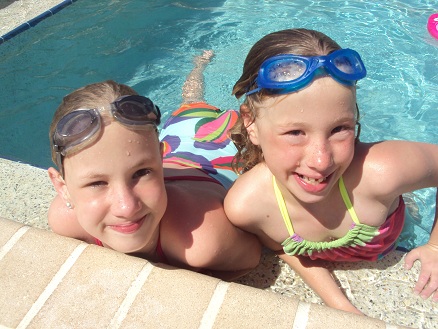
If we oldsters in the autumn of our years could bottle some of the youthful energy surrounding us here in Florida, we’d all have the pep of 18-year-olds after draining the bottle. When our seven enthusiastic young children are at the pool together, other resort guests pick up and leave.

The oldest two, Mary’s twin granddaughters, are the leaders of the pack at nine years old. Witnessing their limitless energy in the water, you’d never know they survived a very rocky start in life.
Hannah and Erika were born almost nine weeks premature weighing 3.12 and 3.5 pounds respectively. When I visited them at the Neonatal Intensive Care Unit (NICU) the week they were born, I wondered if they would make it at all. Their tiny bodies bristled with tubes and wires, hooked up to the best that medical machinery could offer.

When Hannah contracted meningitis and Erika evidenced heart trouble, anxiety ran high. But day-on-day, they gained weight and strength, leaving the hospital a month later.

Their young mommy, my niece Julia, did a stellar job nursing them, no small feat for two tiny babies who needed frequent feedings. She was grateful for each day’s progress and never complained about her daunting task. Today she’s every bit as thankful for their presence in her family as she was the day they were born.

Julia and her husband Drew had a jump on the rest of us in terms of viewing their children as God’s creative handiwork. Our babies came at full term without crises, and we took that blessing for granted. But the twins (and their younger brother Andrew) are so appreciated, their parents take advantage of every opportunity to turn their attention toward the God who made them.

Hannah and Erika were taken on their first mission trip at six years old. Including them on a journey to Ecuador was a risk, but the girls’ world view is shaping up to be full of tenderness toward the poor, partly because of that trip. In preparation for serving with their parents and other families, the girls were told of children who lived with their parents in a dump, scavenging food others had discarded.

After returning home, the twins prayed for the people they’d met. One evening after Julia had dished up dinner, Erika took her untouched plate of food to the trash and began scraping her food into the garbage. “What are you doing?” Julia said.

“I’m sending my food to the children who live at the dump,” Erika said. Although the Ecuadorian families would never receive that offering of love, God did and was extremely pleased with her sacrifice.

Linking that incident with the twins’ early days in the NICU, none of us can doubt God had eternal work for these two fragile preemies to accomplish. And they’ve already begun.

God actually has important work for every life to accomplish, and that includes even those born too prematurely to “make it” on this earth.

It also includes all who’ve had their lives snuffed out before they even have a chance to be born.

“We are God’s handiwork, created in Christ Jesus to do good works, which God prepared in advance for us to do.” (Ephesians 2:10)

The Desserts of Life

While having a sleepover with my Knoxville friend Marge (en route to Florida), we sat at her kitchen table late into the evening talking about our lives as widows. She believes, as I do, that God is looking out for us, steadily taking care of our needs. Once in a while the Lord adds to that basic care, just like a yummy dessert sometimes follows a gourmet meal.

Marge has a name for these moments and the reason why they happen. She calls them “the desserts of life,” a little something that’s unnecessary but sweet. And the reason? God.

As we talked, our conversation was punctuated with these desserts. For example, the two of us stood at her upstairs bedroom window facing west. She said, “Sometimes I come here to watch the sunset. One especially pretty sky made me run for my camera. Just when I was ready to click the shutter, a crowd of geese flew by in a perfect V, and I snapped it. The picture is a lovely reminder of God’s presence in my life, a sweet dessert.”

Marge detailed a second example. The day her father died she was managing a job, a home, four kids and both parents in the hospital. Not knowing her father was near death, she arrived during visiting hours, walking past long elevator lines to the freight elevators in the back. When the doors opened, there was her father on a gurney, headed for emergency surgery. In a few critical moments she learned of his fragile condition, ministered comfort to him, told him what a wonderful father he was and kissed him goodbye. A dessert of life.

One more little example. After my root canal I needed the crown repaired. Calling the dentist’s office I said, “I’ll be in the area tomorrow. By any chance is there an opening?” It was a dessert of life to hear the receptionist tell me I’d called “at exactly the right time” because someone had just cancelled and there was an opening for me.

These desserts of life are labeled “coincidences” by most people but not by Marge. She’s daily trusting God to take care of her and as a result is quick to feel his touch. Then, as she attributes the unusual happenstances to him and acknowledges them as his gifts, her trust grows, and her joy increases.

She’s getting better and better at recognizing him and is savoring one tasty dessert after another.

Dessert… trust… joy… dessert… trust… joy.

“The Lord will tear down the house of the proud, but he will establish the boundary of the widow.” (Proverbs 15:25)


A Rustling in the Reeds

Sanibel Island is a tropical paradise we northerners greatly appreciate after a cold, snowy winter. But even a tropical paradise has its down side. A Sanibel vacation sometimes includes encounters with alligators, terrifying to me.

I remember one night years ago when our  group of a dozen adults met at a restaurant several miles up the coastline. Three of us had taken advantage of Sanibel’s network of smooth, asphalt-paved bicycle paths that link most everything on the island, and had roller-bladed to the dinner.

On our journey home afterwards, the sun had set and the path was dark. Much of our route ran parallel to a briney canal favored by alligators, and as we rolled along, we heard occasional rustling in the reeds just inches off our path. I couldn’t skate fast enough and was surprised when we reached home without an alligator incident.

Yesterday Skylar and I were walking Jack, and she was learning how to hold his leash. Jack’s sniffing led us into the underbrush near a mossy canal, so I told Skylar we needed to back away, since alligators lived in there. We’d seen them many times, and when she didn’t respond I said, “Sometimes alligators eat dogs.”

Loving Jack as she does, that did it for her, and she quickly yanked his leash to pull him in the opposite direction. There’s nothing wrong with healthy fear, and alligators are to be feared. Every so often we learn of an attack, and in recent years we did read of a gator eating a dog.

Tonight I’ve been pondering my fear of alligators, along with other dangers we might not be able to see but are lurking near our life-paths. Do we fear the things we ought to fear? When we hear a “rustling” nearby, such as a fluttering of desire for something we know to be wrong, do we fear its consequences and immediately yank ourselves away, moving in the opposite direction? Or do we say, “It’s just a noise, nothing to fear.” Lowering our defenses against something that may be potentially dangerous can quickly escalate and become life-threatening.

Scripture tells us sin of all kinds, initiated by Satan, is quietly waiting nearby in hidden places. It lurks close to us like a coiled snake in the weeds or an alligator in the reeds, ready to pounce in a blur of quick movement. Without paying attention to the quiet rustlings deep within and heading in the opposite direction, we’ll be in trouble for sure.

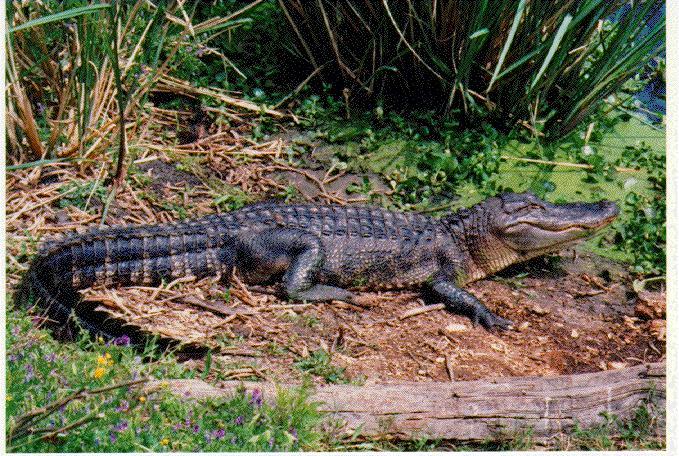
Yesterday Skylar got to see a real alligator sitting in a swampy area of the resort where we’re staying. Even though she’s just two years old, she wasn’t frightened. “He looks like a log,” she said, and of course no one is afraid of a log. But I’ve seen this kind of “log” defy appearances and move like lightning. It’s important to keep a distance, and if it “rustles”, head in the opposite direction.

Concerning sin, there are harsh consequences for not yanking ourselves away.

”If you do not do what is right, sin is crouching at your door; it desires to have you, but you must rule over it.” (Genesis 4:7)

Posted in Sin