Cleaning Up

I know three women who clean houses for a living. Every time I’m cleaning, I get a mental picture of these three and stand amazed at the energy they have for their work. I struggle to clean a single house well; they clean one after another.

But cleaning in manageable doses can be very satisfying. It isn’t the scrubbing, kneeling, reaching or lifting that gratifies but the end result. After putting a messy room in order, each time I walk through, I get a little kick.

Today I tackled our disheveled cottage. Before my grandbabies came, I went through and babyproofed the house, although once they arrived, we steadily took it to higher levels (literally). Today, however, I reversed the process, bringing everything back down to its former place.

Scrubbing food off the upholstery, raisins off the carpet and toddler hand prints off the windows brought five darling faces to my mind, followed by a flood of gratitude for these precious little ones. But as my sister says, “When the grandkids come, the house takes a heavy hit.” The beauty of it, though, is that with a little soap and water, Windex and Pledge, order is restored.

Today as the wash machine worked its magic on sheets and towels, I thought about the process of internal house cleaning. My childhood Sunday school teacher often referred to the “heart” as a group of rooms, each with a door that could be locked. She urged us to unlock and open each one when Jesus came in, inviting him to inspect every room.

The teacher’s grand-finale question was, “Are there any rooms in your heart you wouldn’t want Jesus to see?” Occasionally I still ponder that. Are all my heart-rooms cleaned up and open to Jesus’ inspection, even in their shadowy corners?

Such a question is, of course, ludicrous. He can look at anything he wants to and is capable of seeing past locked doors and into dark corners. But Jesus himself used the heart’s-door analogy in his own teaching, illustrating difficult principles with this simple, everyday picture. One thing he never did, though, was demand we open up for him. Instead it was always a gentle inquiry. Whether or not we let him in is left up to us.

I long to throw open all the figurative doors of my life in response to Christ’s presence, but often there are issues to deal with first. Just as with my cleaning house today, I might say, “I can’t have company until the house is ready.”

But the beauty of letting Jesus come in even before every nook and cranny is in order is that once he gets access, he’ll enthusiastically help with the rest of our cleaning. We can fling wide every door without hesitation or nervousness, and we can do it now.

Even if we’ve run out of Windex or Pledge, it won’t matter to him.

“Look! I stand at the door and knock. If you hear my voice and open the door, I will come in, and we will share a meal together as friends.” (Revelation 3:20)

Skipping Christmas but not Skipping Tears


Every December my sister and I spend an evening with the Kranks, a family we met in 2001 by reading John Grisham’s book, Skipping Christmas. It’s about a middle-aged couple hoping to duck the expense and demands of a traditional Christmas season by taking a cruise.

When the movie came out in 2004, Mary and I rushed to see it. One of her daughters came along but was so embarrassed by our raucous guffawing she nearly walked out. Ever since then, we’ve revisited the Kranks and their illogical antics each Christmas season, looking forward to laughing together at the same places we always laugh.

This year, due to the combination of illness and family commitments, Mary and I failed to fit in our tradition but never lost the desire. Last night, several weeks late, we finally got our opportunity.

We ordered Chinese food, settled with our tea and beef with broccoli on Mary’s upstairs beds and hit the DVD “play” button. Watching Tim Allen and Jamie Lee Curtis make a mess of things was just as hilarious as we remembered, and we took pleasure in every scene.

But then we came to the cancer part. Because we’d seen it before, I knew it was coming but was surprised by my sad reaction. The storyline has a sixty-something couple living across the street from the Kranks, and toward the end of the movie, the wife discovers her cancer has recurred. Conversation hints this will probably be her last Christmas.

As the camera looked across the snowy street into their picture window, we saw them dining alone on Christmas Eve, and suddenly my eyes brimmed with tears. Although these were actors in a fantasy, my heart believed what it saw and thought, “Your immediate future is going to be awful. Enjoy your ‘normal’ dinner together, because it’s not going to last. Misery is on its way.”

I haven’t cried about Nate’s cancer or about losing him for many days in a row. My kids and I talked often about him during the holiday weeks, which was a deep satisfaction to me. Tears were not part of it, and I felt I was doing well.

Then there was the movie and my tears, a reminder of what widow friends have said. “The triggers are there, just beneath the surface, and you’ll be taken by surprise at the oddest times.”

Tears about cancer during a comedy movie would qualify as odd but also as oddly normal. Although it’s difficult to explain, as the tears came, they were soothing, an oxymoron of mourning. Although I don’t cry every day, I’m still grieving the death of my husband. And until earthly life ends, I always will be.

Thankfully, I had my snowman napkin to dab at my eyes, and as the movie concluded, its ending was optimistic. I’m conscious of God’s careful monitoring of my emotions and know he’ll encourage tears whenever it’s right.

I’ve abandoned myself to his flawless care and his consoling promises.

“Your widows… can depend on me.” (Jeremiah 49:11)

Seven Birthday Trees

On several occasions, we Nymans have been criticized for having such a big family. “Seven kids? What a giant environmental footprint you’re leaving.”

I have a friend who was walking into the Field Museum with her seven kids when she was approached by a stranger. “Are these all yours?”

“Yes,” she said.

“Then you’re breathing more than your fair share of the earth’s oxygen.”

It was rude and inaccurate, spoken like the disgruntled person she probably was, but it gave me an idea. Each of our children should plant a tree. It would give off oxygen and take in some of the carbon dioxide they breathed out. It would also provide a snap answer to a criticism, should another come.

Even though every human being would need to plant an entire acre of trees to bring balance to the O2-CO2 ratio, we could at least participate symbolically. We decided to let each of our kids plant a tree in the yard just as they were leaving home for college or other pursuits at 18.

Nelson was the first and chose a weeping willow. He knew they were fast-growing and loved the sweeping branches. His willow sapling had a trunk no thicker than his finger but true to its reputation, grew tall quickly. When we moved recently, it had grown into a healthy specimen of 50 feet, its “weeping” branches long and strong.

Two years later, Lars chose a sour-cherry tree, because he loved cherry pie. His tree also started small, and although it yielded a small cherry crop each year, the birds always got them before we did. Several years in, it began to suffer and eventually died. We quickly replaced it with a same-size, same-kind of tree, and it’s been growing well since then.

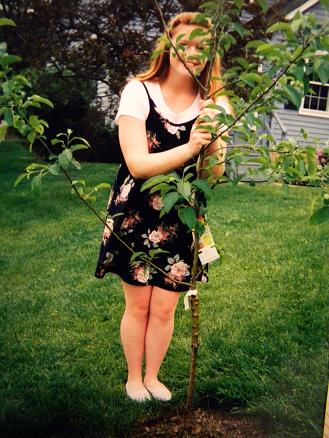
Linnea’s tree is a resurrection story. Because she loved apples, she chose a golden delicious tree, but our high-strung dog Penny spent hours gnawing its branches until only a stump remained. Surprisingly, after Penny died, the stump began growing again, eventually flourishing and producing apples.

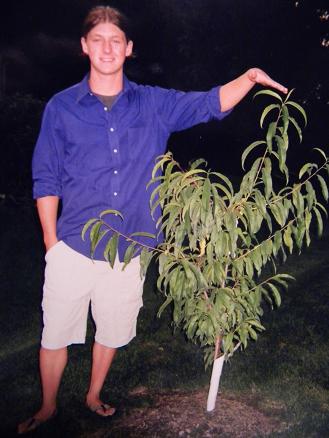
Klaus chose a peach tree. The first spring it produced literally hundreds of peaches, too great a burden for such a little tree. We plucked off buckets of ping-pong sized fruit, leaving about 20 peaches to grow to full size. Even then, the little branches needed wooden supports, but the peaches were big and juicy.

Hans admired Nelson’s weeping willow and followed suit. We planted it in a sloppy downpour the morning he left for his Tennessee university, and after a minor set-back, his tree has grown quickly and flourished.

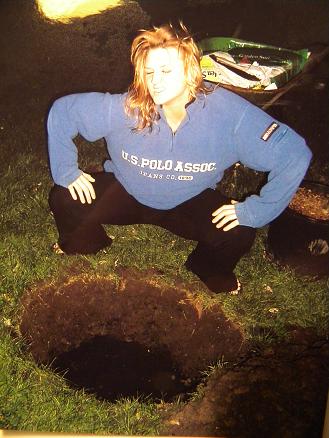
Louisa chose a decorative crab with giant white blossoms. Shaped like an umbrella with its branches cascading like falling water, it found a home in the center of the front yard where I enjoyed its beauty from the kitchen sink. Sadly, the week after we moved, someone dug it up one night and stole it. Only the hole was left, a bizarre end to a short story.

Birgitta chose a mighty oak no taller than she was but with the potential to outlast all the others. The day we dug its hole, we’d gotten two feet deep when we hit a rock. In a half-acre yard, we’d chosen the exact spot where a three-foot wide boulder was hiding. Digging a second hole, we set her oak in full sun, and it’s gaining steady growth every year.

Each tree choice reflects the personality of its buyer, and I hope as the years pass and the trees continue to grow, our kids will give God the credit. I also hope they’ll appreciate the variety in his creation and will point to him as they “show off” their trees one future day.

But we’ll have to come up with a better ending for Louisa’s story.

“The seeds of good deeds become a tree of life.” (Proverbs 11:30a)