What if?

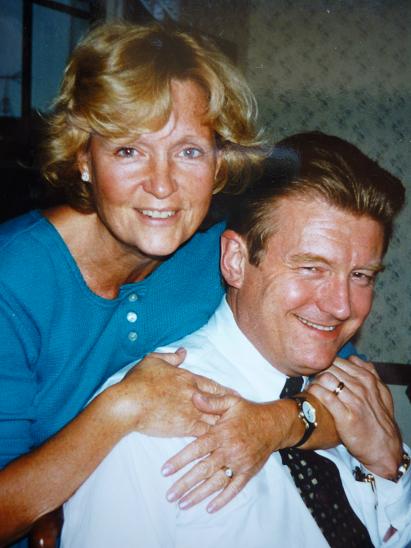
 Sometimes I miss Nate so much I allow myself a ridiculous fantasy that may or may not be healthy. It’s reminiscent of a movie scene in which the woman sees a walking figure afar off, unsure of who it is. Suddenly she recognizes a familiar walk and realizes it’s her beloved. A shiver travels through her like an electric current, and she flies toward him, stumbling over her own feet to get there quickly. They swing around in a loving embrace of happy reunion.

In my make-believe movie scene, this is how I let myself see Nate, appearing at the distant end of our narrow lane, walking steadily toward me. I’m aware we won’t have a happily-ever-after, but I feel sure we’re going have at least a few minutes together, enough to cover a great deal of conversational ground. My longing is not to waste one second of the experience.

After I race toward Nate and we enjoy an embrace, we begin to talk. He’s clear-eyed, smiling and full of peace as he looks at me. I’m full of questions, sputtering them out like machine gun fire. “What’s it like where you live? Have you met Jesus? What did he say? Did you meet our miscarried baby? Boy or girl? Did the baby recognize you? Have you seen our four parents? Have you met Adam and Eve? Moses? Elvis?”

There’s so much I want to know, I can’t make myself stop asking to wait for his answers. When I finally stop, Nate lovingly squeezes me and says, “You’ll get your answers all in good time.”

“I miss you so much it hurts,” I say, “and I love you more now than I ever did. I wish you could come back home. Can you?”

He looks me straight in the eye and says, “Would you want me to re-enter all that pain and disease? Life wasn’t good for either of us then.” He’s tenderly holding my elbow now, achingly reminiscent of the way he used to assist me up every curb without realizing it.

My heart screams, “Tell him you want him back, even like that!” But the rest of me remembers the pain and misery, and I can’t say it.

I drop my head in disappointment, acknowledging the sad truth of our new separation. Nate puts his arm around me and says, “God did the merciful thing, the kind thing, in taking me from this earth and from our family when he did.” I knew he was right.

Too soon our time is over, and Nate must leave again. Before he goes, though, he bends and gives me a long, firm hug and says, “Don’t worry about answers to your questions. Your future is nothing but glorious!” And then he smiles goodbye and walks away, back down the road. I stand there crying but know that chasing him, grabbing onto him, won’t keep him with me any more than it did when I held onto him as he died. Nate and I are in different worlds now, and neither of us can live with one foot in each.

Once his walking form is out of sight, I turn and walk back up the lane to my empty cottage, trying hard to retain the feeling of his hug and the other-worldly peace of his eyes. In not getting the answers to my questions, my only choice is to be open to not knowing.

Although I may have to wait 20 or 30 years to participate in the “glorious future” Nate referred to, I have no doubt that one day the same reality will be mine. And on the day I leave this earth, as I dimly hear voices saying, “Goodbye!” I’ll also hear voices saying, “Hello!”

And Nate will be among them.

“Let this be recorded for future generations, so that a people not yet born will praise the Lord. Tell them the Lord looked down from his heavenly sanctuary. He looked down to earth from heaven to hear the groans of the prisoners, to release those condemned to die.” (Psalm 102:18-20)

May 16, 1981


The day our Klaus Fredrik was born, Nate was out of town. He had taken Nelson and Lars on a father-son retreat and hadn’t returned yet, when I realized I was in labor. Mary was on hand, excited to fill in as my delivery coach, but just as we were ready to drive the 45 minutes to the hospital, Nate and the boys drove in. Since he’d been part of birthing the three older children, it would have been a disappointment if he’d missed the fourth. We left Mary and the children at our house around 7 pm, and Klaus debuted in a photo finish at 8:07 pm.

Later, as Nate and I sat in my low-lit hospital room that evening, our prize cradled in Nate’s gowned arms, we tried to decide on a name. Nate loved the name Klaus, but I preferred the name Hans. “My choice means ‘gift of God’,” I said, in an effort to pull his vote my way. “What does yours mean?”

“I’m not sure,” he said, “but I recall it’s something very positive. I tell you what. When I get home tonight, I’ll look it up and call you. If it’s a really good meaning, can we name him Klaus?”

I was thrilled our new baby’s father was passionate about naming him, and agreed. In those days, the hospital switchboard didn’t allow calls to come to the maternity floor after 10:00 pm, so Nate arranged to call the nurse’s station. They promised to notify me then, after which I could phone him back from my room.

“Guess what!” he said, when we finally connected at midnight. “’Klaus’ is a great name to have! It originates from ‘Nicholas’, and if we spell it the Swedish way [which we’d been doing with our other children’s names], it’s spelled ‘Ni-klaus’. It means ‘victorious in battle.’ Isn’t that a great way to start life, knowing your name means victory?”

I had to hand it to him. Thinking of life’s inevitable battles, ‘Klaus’ would be a fabulous name to bear. And that was that.

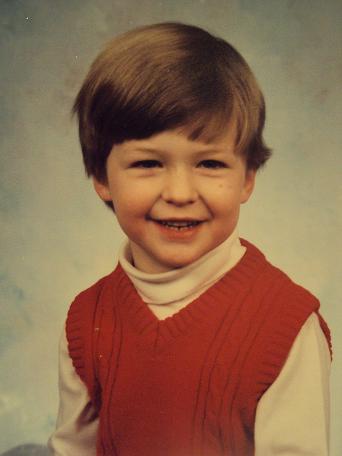
Klaus was born with optimism on his face, finding something positive in every situation.  He expresses his joy in life through writing and singing music and in upbeat conversation focused on life’s blessings. A student of people, he looks for the good in everyone, making friends with ease.

 Children gravitate toward Klaus. He’s got that certain something kids love, and he knows just how to fascinate them. If there’s a child in the room, Klaus is in front of him or her, working hard to win a smile. If some day he is fortunate enough to be a father, his children will be greatly blessed to have him as their dad. Little ones know no greater joy than that their father genuinely loves to be with them and chooses them over other things he could do instead.

Good times follow Klaus, and he is skilled at dispelling inertia and organizing people. But even better than a happy evening are the times when he gains new insight through his growing relationship with the Lord, a friendship he is eagerly pursuing daily. And on his birthday, this brings immense joy to his mother, who in her heart is celebrating with him from across the Atlantic Ocean.

God was good to us on May 16, 1981!


“Those who trust in the Lord are as secure as Mount Zion. They will not be defeated but will endure forever. O Lord, do good to those who are good, whose hearts are in tune with you.” (Psalm 125:1,4)

Accomplishing the Impossible?

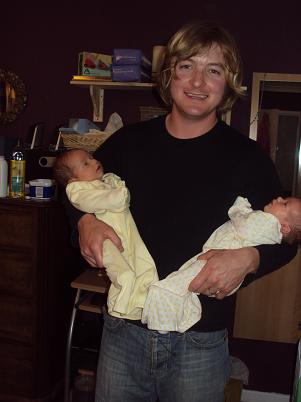
Here in England, this grandma has been immersed in the brand new world of twin newborns. Although I had seven children, they all came as singletons. I longed for twins, fantasized about raising twins, loved thinking of coordinated twin names and dressed my close-in-age children in twin outfits. But never have I been in the twin-trenches until now.

Katy and Hans, parents of Evelyn and Thomas for all of three weeks, are handling the situation with aplomb. This is due partly to instinct and partly to the expertise of others, but the philosophy that’s working for them is to get both babies highly scheduled. The theory is that babies can be taught to remain awake and go to sleep according to set times, as long as the timetable is adhered to carefully during the first months of life.

Years ago I’d heard about scheduling newborns and had read a book called “My First 300 Babies” by Nanny Gladys W. Hendrick. She established rules like daily outdoor exposure for babies of at least an hour, including during the winter. She also advocated alone-time in their rooms for all children to learn to entertain themselves, whether newborn or older. Well defined sleep and awake times were part of the schedule, as was private time for mother, which was the part that motivated me to read the book.

Although I lifted several ideas from Gladys’ counsel, most of it didn’t work for me because I wasn’t willing to comply with one of her hard and fast rules: awake time. My motto was, “Never wake a sleeping baby.” She would have called that a slippery slope.

She was right. I paid a big price for not bringing some form of routine into mothering my infants. Because of my dread of night time and the unpredictability of our new babies, my stress during those first weeks grew daily, and the 20 pounds I put on after each pregnancy testified to the crisis-mode of those post-partum months.

Katy and Hans are extraordinary. They both studied a book they got during their pregnancy, “A contented House with Twins,” by Gina Ford and Alice Beer. When they arrived home with their two-day-old babies (and 15 month old Nicholas), they started immediately on Gina’s recommended timetable. They’ve found, in only three weeks time, that these tiny babies are beginning to “get it.”

Part of their regimen is to follow the rules, such as never going less than two or longer than three hours between feedings, putting them to bed by 7:00 pm, refusing to let them sleep more than five hours during the entire day and allowing them three feedings during their 12 hour night.

Katy and Hans have not allowed themselves to be put off by even the roughest parts of the schedule. As Katy puts it, “The hard bit it keeping them awake during the prescribed times.” And yet she does it.

I marvel at her determination during the day. If one of our little charges dozes off when he/she should be awake, baby gets patted, then head-stroked, and if still snoozing, the sleeper gets taken off. If that doesn’t work, the undershirt comes off, too. If still asleep, the little one’s face gets washed. By then he/she is crying, but awake. And all of that is why my weak efforts to schedule my own newborns always failed. I had refused to do the hard part.

Now, however, I see this system bearing fruit. Although there are setbacks, overall Thomas and Evelyn are gradually complying. It has meant clock-watching, record-keeping and high-decibel crying when awake-time is needed. But two invaluable treasures are emerging:

(1) Katy and Hans have three hours of quiet togetherness from 7:00 to 10:00 pm (with occasional exceptions, like last evening).

(2) During the night they’re up to change and feed babies for only two 45 minute periods.

So here I am, advanced in years, understanding that my mothering mantra to “never wake a sleeping baby” wasn’t a very good one. And most remarkably, I’m seeing how God gave brand new babies the ability to learn difficult concepts. Children truly are his miraculous creations.

”No discipline seems pleasant at the time, but painful. Later on, however, it produces a harvest of righteousness and peace for those who have been trained by it.” (Hebrews 12:10)