
Digging Deeper

The home we raised our family in was a 100+ year old farmhouse located near a creek. I loved to think about the farmer choosing that spot to build his house, up on a rise near free-flowing water that would satisfy household needs. In the late 1800’s, this family probably drew all their water from that creek by way of heavy wooden buckets.

Our old house

After we’d bought the house, we had a surprise visit from the “little boy” who’d been part of that first family. He was in his 90’s then, bent over with age, but his memories of the house were rich. We walked from room to room, and while standing in the corner where he said his mother had worked at a dry sink, he told of the well his father and brothers had dug. It was an upgrade from the creek, but she had complained it was too far from the house.

He then told of the grand day his father had dug a closer well and linked it to a hand pump on the front stoop. (That explained the 3” round hole in the concrete.) Of course eventually they had running water, and just before we moved in, a fresh well had been dug to a depth of 127’. The water quality wasn’t good, but with a line-up of purifying tanks in the basement, it was acceptable.

A creek-water bath

After living there 12 years, one day I drew a bath for the girls, and the tub filled with very strange water. It had gritty soil in it and looked much like the creek water flowing outside. Our girls loved their “black bath” and felt like they were playing in the creek.

The next day a well-man gave us the bottom line: “Your well’s going dry, and you’ll need a new one.”

After accepting our fate, Nate told him, “Dig deeper this time. Maybe you’ll find better water.”
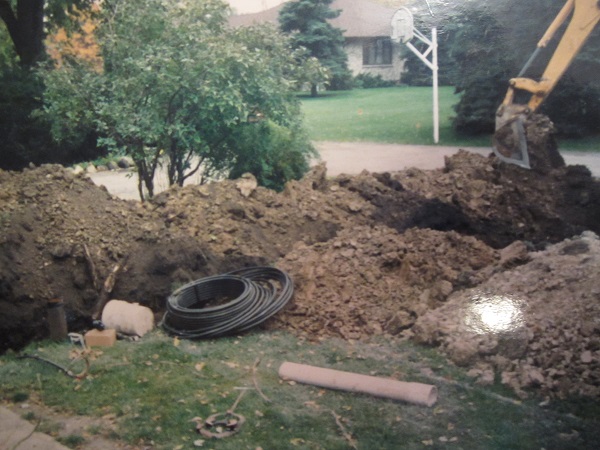
Dig right in.

A week (and $12,000) later, we had water again, this time from a 165’ depth. There was bad news and good: the water quality wasn’t any better, but the well pipe had hit a deep vein of water, assuring us we wouldn’t run dry again.

I thought of how quickly we were willing to “dig deeper” to get the water we needed, both in the yard and in our pockets. Are we just as willing to diligently dig for God’s truth? How much effort and expense are we willing to put forth?

In the USA we can “taste” spiritual water with virtually no effort or expense. It’s on the car radio, at the corner church, on our TVs, on the internet. The question is, have we cheapened God’s pure provision by wading through its abundance without actually drinking it in?

165'

If that’s true, God’s love will see to it that we inevitably “dry out” to the point of craving his water like someone dying of thirst. And when that happens, no effort or expense will be too great to quench our genuine thirst for him.

“Whoever believes in Me will never be thirsty.” (John 6:35)

Do the Opposite

Many times the will of God runs contrary to the will of us. He comes at problems from a different angle than we do, and we all know his thoughts are nothing like ours. So why are we surprised when he doesn’t want to do things like we want him to do?

George

I remember a Seinfeld episode years ago in which everything went wrong for one of the characters. Once he figured out that his repeated failure was a result of his own poor decision-making, he decided to try a new approach. From then on he would do the opposite of what he thought he should do, hoping for success in that way.

Strange as it may seem, that do-the-opposite approach actually worked for him. And as I’ve been thinking about God’s ways vs. ours, maybe the same tact could work for the rest of us, too.

In the middle of pondering this, my son Nelson’s newest blog post arrived to my inbox. He’d written it in one of the many airports he’s passing through on his way from the Youth With A Mission base in Hawaii to Thailand. Two quotes from him:

Airport line

  1. When I don’t have enough money, I should give some away.
  2. When I feel like there’s not enough time, I should let someone go before me, making me even more behind than I already was.

And there it was, the do-the-opposite living that seems to connect with the Lord. Why would a logical God ask us to do such illogical things? Nelson gave us the answer: because it leaves the outcome up to him.

The scriptural Paul studied this same dilemma and by sheer will power determined he’d live by a do-the-opposite philosophy. He very much wanted to please God and tried hard, but white-knuckling his way through didn’t work: “I want to do what is good, but I don’t. I don’t want to do what is wrong, but I do.” (Romans 7:19) Thinking like God was the opposite of what his heart wanted.

His conclusion was that mankind has no natural goodness in him, which is probably the reason we all find it difficult to think like God. After all, if we have no natural goodness in us and he is all goodness, we’re exact opposites.

So, what hope do we have?

Paul says our hope is in knowing that God is a willing partner in our efforts to live-the-opposite of our natural tendencies. When we’re short on money, he’ll empower us to give some away. When we’re in a rush, he’ll give us the will to let another go ahead. And when we live this way, God will take care of the outcome.

There’s one other benefit, too. To quote Nelson again: “Mastering this kind of attitude actually brings a whole lot more peace than the alternative.”

Paul said, “What a wretched man I am! Who will rescue me? …. Thanks be to God, who delivers me through Jesus Christ our Lord!” (Romans 7:24-25)

Verbiage

Back in high school I took a journalism class that nourished my love for writing. Our teacher repeated several basic principles again and again such as, “Don’t use words that tell me. Use words that show me.”

American International School of Kabul (AISK), Senior English class. Peg Podlich is on the left.

He wanted us to select words that were bursting with visuals, putting an emphasis on choosing good verbs. “If you pick the right verb, you can cut out all the extra words, which enhances the reading.”

After that I watched for interesting verbs in my school books and noticed how they livened up a paragraph. And then one day I decided to check the verbs God used in his book.

No doubt an English language version of Scripture doesn’t give proper credit to the way God originally breathed life into the words of Hebrew, Aramaic, and Greek, and some of his brilliance has been lost to us in translation. But as I read my copy of the Bible, one thing was certain:

God loves verbs.

In doing a quick study of the 100 most often-used verbs in the Bible, I saw that he ignored the writing principle (in relation to verbs) that I was taught in my journalism class. Instead he kept things simple and easy to understand: come; remain; hear; turn; meet; confess; rejoice.

And here are a few more off that list of 100: give; guard; stand; see; deliver; find; love. Studying these verbs reveals something special about God-the-Author. These action words are person-to-person: humanity to humanity, and divinity to humanity. They describe a wide variety of actions that can be taken to have a relationship with him and live our best lives.

And that’s the key: actions. God took the initiative and acted first, then followed that by inviting us to act in response. If we choose not to, we’ll waste his remarkable gifts and promises.

God didn’t write a book with the hope that a clever choice of individual words might pull people in and then hold their attention. He wasn’t interested in producing the perfect “beach read” or a pleasure novel. Instead he wrote out “the words of truth” (2 Timothy 2:15), encouraging us to decide for ourselves whether or not we’ll read them and/or act on them. He used: do; go; choose; serve; remember… words that are clear and simple.

God makes it known in several places in his Bible that this Word is totally complete the way he first wrote it, and nothing needs to be added, subtracted, or altered. My journalism teacher might not have agreed, wanting to circle those simple verbs with his red pencil, but when it comes to perfect communication, I think God would get the A+.

“When you received the word of God, which you heard from us, you accepted it not as the word of men but as what it really is, the word of God, which is at work in you believers.” (1 Thessalonians 2:13)