
Packing Up Possessions

There are two seasons of life: collecting and dispersing. When we get married, bridal shower gifts and wedding presents give us a jump on creating a new home. Then as we travel through the years, we move to bigger digs and eventually add children. Along with them comes a new volume of equipment, and all of it needs space. Children grow, we age, and the pile-up of years can pile up enough possessions to threaten our sanity.

Every once in a while it’s good to take inventory, but most of us are too busy until it’s time to down-size. And suddenly we have a problem.

Because it took four years for our family to sell our big, old house, I had plenty of time to condense our stuff. The first year I set a goal to eliminate 1/3rd or every drawer, cabinet and closet as preparation for the move.

The second year I did it again, this time stretching for half of everything. Storage began to loosen up, and it felt better than going on a diet and losing weight.

More reducing was necessary to squeeze two houses into one, and now, two years later, I’m at it again. We’ve still got too much furniture in our small home, so I’ve made plans to ditch the largest piece, a big china hutch.

This cabinet has housed my beloved collection of glass items for 25 years, and in order to send it out the front door, I needed to eliminate more than half of what it held.

And it was much harder than I thought.

I struggled to decide what to let go of and needed some standard by which to measure each piece’s value, not in dollars but in sentiment. I decided to get rid of everything that wasn’t linked to someone special.

The process wasn’t easy, but that was an excellent reason to do it. I love my glass, but it was glass-gluttony for sure. No one person needs all I had. Scripture tells us to hold our possessions lightly and continually acknowledge that all of it is God’s blessing. Our stuff finds ownership in him.

Jesus told the story of a man who did so well at accumulating, he had to build bigger buildings to hold it all. The result was an identity in what he owned and an inflated opinion of his own importance. Because of those two things, Jesus labeled him “a fool.”

The Lord challenges us to find our riches in a bond with him. People say, “You can’t take it with you,” which is true of all earthly assets. But we can take the Lord’s relationship with us when we die.

And that’s the one possession I’ll never eliminate.

“Jesus said, “Beware! Guard against every kind of greed. Life is not measured by how much you own. A person is a fool to store up earthly wealth but not have a rich relationship with God.” (Luke 12:15,21)

Waiting

Today I spent nearly three hours standing in line at an office that was trying to service too many people. We waited in single file along the wall of a long, narrow corridor, hoping to be heard.

When I arrived, I asked another line-stander how long he’d been there. “Two hours so far,” he said.

The young student in front of me was a guy I’d seen 24 floors down at the lobby security check. I’d been ahead of him in that line, but somehow he’d gotten to the new line ahead of me. I berated myself for wasting 30 seconds finding the right elevator.

So we waited. A man with a cane (complaining loudly) was finally given a chair, but a second complainer was told to sit on the floor.

When a man arrived with a little girl Skylar’s age, I knew they’d never make it. She’d brought a pink back-pack full of activities, and he’d filled his pocket with candy. But after 90 minutes they’d run through their entertainment and gave up, ducking under the ribbon “fence” and heading home.

Although it was frustrating to wait in my poorly chosen shoes, the people-watching was fascinating. Each new arrival began by asking the official at the head of the line, “Where do I go to talk to someone about my problem?”

And to each person he’d say, “Get in line,” while pointing a finger in our direction. Mouths dropped open and objections were made. “I’ve got to get this done on my lunch hour!” (Chuckle, chuckle and another point to the end of the line.)

Or, “This is my day off. If I don’t get it done today, I’ll have to wait a whole week!” (Chuckle, point.)

When the clock inched toward closing time, the representative arrived to knock off most of the waiting line. “We won’t get to any of you people today,” she said, sweeping her hand over most of those waiting. Their groans rose up in unison.

I was third-to-last, grateful I could continue to wait. Sadly, at the end of the meeting, my advisor couldn’t help except to suggest several other offices with new lines to stand in.

Today’s waiting ordeal was a perfect picture of why we have trouble waiting on God. Just as the authorities wouldn’t let us even look into the room where we hoped to go, God doesn’t let us see our future or the details of how our prayers will be answered. And just as we had no idea how long our wait would be, the Lord doesn’t clue us into how long our troubles will last. And just as the office personnel had all the power today and we had none, God is sovereign over the events of our lives. And just as we grew uncomfortable as the hours passed, waiting for the Lord can become downright painful.

When the waiting ordeal was over and I finally got back to my car, I vented to Jack, who had been waiting, too. He wagged his tail as if to say, “Welcome to my world.”

“Wait for the Lord; be strong, and let your heart take courage; wait for the Lord!” (Psalm 27:14)


Giving Her All, Part 2 of 2

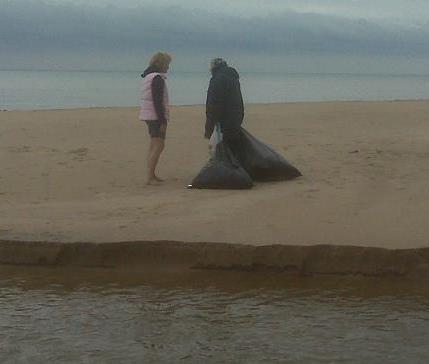
After the elderly stranger fell face-down into deep creek water, Mary and I ran to help. But as we arrived, her head lifted above the water, and she began crawling with her heavy garbage bags to the opposite bank.

“Are you all right?” Mary shouted.

“Fine,” she said. “I just need to drip dry.”

Jack had followed her into the water, and when she saw him, she talked to him. “Hey! Get my rake, and bring it to me!” She had dropped the rake during her dunking.

I pulled off my shoes and socks, rolled my pants and crossed the frigid, fast-flowing creek, fishing out her rake on the way. Again she refused my help with her bags, but as she stood, wet from head to toe, she began to talk.

“Many people have been mean to me, from when I was a little girl” she said. “My parents locked me in a room to keep me from hugging Charlie the horse. They were worried I’d get kicked.”

She told stories of her husband and son, both deceased, but assured me they were caring for her from the hereafter, sending signals when they were near her. She described a babysitting job when the doorbell had rung twice, but there was no doorbell. “That,” she said, “was my husband and son.”

“I’m 76 years old now,” she concluded, “and God has always watched out for me.”

She said she lived six miles from the lake and was planning to walk home after she’d stowed her gear. “Six miles?” I said, alarmed, worrying about her being soaked and cold.

“It’s good to keep moving,” she said. “Besides, I’ve had the pneumonia shot, so I can’t catch that.”

As she bent down for her water-logged garbage bags, I reached for one of them, but she wrestled it away. “No. I’ll do this,” she said. Mary, on the other side of the creek (taking phone pictures) worried she might strike me.

Before she left, I asked her name. “Thelma,” she said.

As she shuffled toward the dune, Mary and I bolted for home, hoping to quickly drive back with dry clothes, a bit of food and a six mile lift. When we returned, we walked the dunes, checked the yards and drove the streets. But she had vanished.

Both of us were disturbed for hours after our encounter, wondering what to do or think. We agreed she was an excellent example of perseverance, but toward what end? Scripture praises perseverance, but only when the object of our quest is a worthy one: godly character, or the Lord’s calling, or holy living.

Some people show determination, but not toward wise behavior. Instead they persevere in disobeying God or trying to live independently of him, or they show determination in giving in to sin. That kind of perseverance is rebellion. In Thelma’s case, she had the right idea, but the wrong goal. Working hard is a virtue, but risking drowning for the sake of two garbage bags full of leaves is foolishness.

So how do we know if we’re persevering after a worthwhile cause?

“The one who looks into the perfect law [God’s Word], the law of liberty, and perseveres, being no hearer who forgets but a doer who acts, he will be blessed in his doing.” (James 1:25)