A Good Friday Surprise

Spring is inching its way into our neighborhood. After a winter that’s lasted too long, the forsythia, daffodils and blue-bells are a treat. Ground covers are blooming, and once in a while we stay above the 30’s overnight.

This morning as Jack and I started our walk, the strangest thing happened. Half-a-block from home we saw a sad-looking daffodil lying on the road, dusted with dirt. The stem had been neatly cut at an angle, but there it lay without explanation.

I stepped over it, and we continued on. Fifty yards further we saw another one… and another… and finally several. The only possibility I could imagine was a woman setting her flower vase on the car roof for a minute, then forgetting it was there as she drove away.
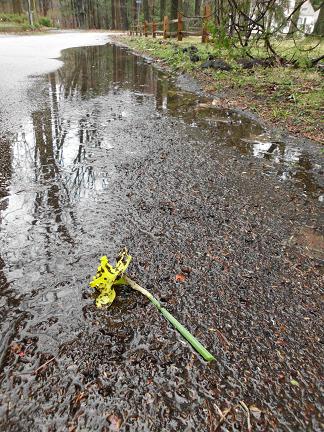
Jack and I pursued our walk, but at the farthest point from home, it began to pour. We picked up the pace, and I thought of the mysterious daffodils now lying in the mud. Deciding to rescue them, we walked past the house, retracing our steps to retrieve the flowers.

Mentally creating an Easter bouquet, I also snapped a piece of evergreen growing near the road to frame the daffodils. After gently swishing everything in a bowl of water and putting them in a crystal vase, they were an eye-catching display.

Tonight as I studied my pretty bouquet, God brought an old memory to mind. Mary and I were little girls and Mom was teaching us to sew. “We’ll make sachets for your drawers,” she said. “Your underwear will smell fresh, just like the outdoors!”

She took us out and directed us to the same type of evergreen I’d put with my daffodils this morning. “Pick this kind,” she’d said. “It smells best.” She’d pinched a small sprig between her fingers, putting it under our noses to prove her point.

We stripped our branches until all we had were piles of green “needles”. The room filled with a woodsy aroma, and I still have the pine sachet I made that day, sewn with a nine-year-old’s crude stitching.

Tonight God revealed an important Good Friday lesson having to do with that evergreen. In order for us to be included in heaven’s promise, Jesus needed to be crushed, much like Mom squeezed that sprig years ago to release its good scent. As excruciating as it was for the Father to turn away from his suffering Son, it was the only way we could have experienced salvation. His death became a sweet-smelling sacrifice to the Father.
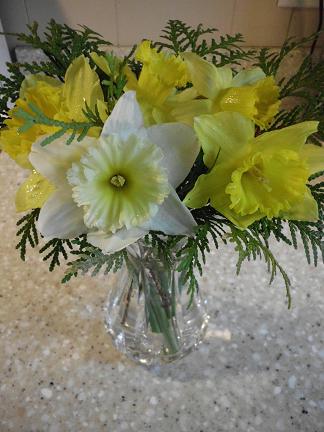
As I looked in amazement at my bouquet, the Lord whispered something else. “Although you stepped over the dirty daffodils and picked them up only as an afterthought, I’ve never stepped over a dirty sinner. None of them, including you, will ever be an afterthought to me. You are front-and-center.

And that’s why I died for you.

“He was pierced for our transgressions, he was crushed for our iniquities. Christ… has loved us and given Himself for us, an offering and a sacrifice to God for a sweet-smelling aroma.” (Isaiah 53:5, Ephesians 5:2)
Floored

In January of 2008, I made a request of God, asking for a gift I hoped to receive from him during that year. I’d been bothered by my over-familiarity with the crucifixion story and asked him to increase my understanding of Jesus’ sacrifice.

I longed to get away from the Christian-ese vocabulary hindering an accurate perception of the cross but had no idea how the Lord could teach me what I longed to know.

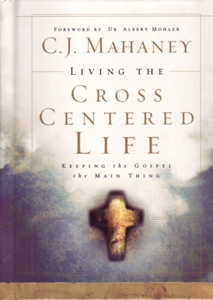
Birgitta and I were part of a mother-daughter Bible study that year, and when our leader announced we’d be studying C.J. Mahaney’s book, LIVING THE CROSS CENTERED LIFE, I was disappointed. The title didn’t sound much like high school daughter material. Little did I know God planned to use this little book (no bigger than a 5 x 7 photo) to answer my January prayer request.

We were nearly half way through the book when God shocked me by revealing something that wasn’t about Jesus but about me: the depth of my own sin. The way he did it impacted me forever.

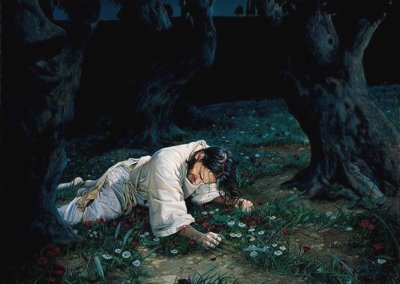
Mr. Mahaney wrote, “Knowing the hour of His death is fast approaching, Jesus has come here (Gethsemane) in need as never before of his Father’s comfort and strength. Instead, hell – utter separation from God – is thrust in His face. He confronts total abandonment and absolute wrath from His Father on the cross, a distress and an abandonment and a rejection we cannot begin to grasp.”*

As the truth of this terrifying picture settled in on me, I began to tremble with horror at what I’d done, how disastrous my sin was for Jesus, not just the big things I was sorry about but the teeny sins I’d brushed under the rug. All of it. Any of it! And I started to cry.

Unable to read through tears, I left my book and the chair and knelt on the floor, blubbering my grief to the Lord, brokenhearted over my guilt in front of him. He continued to show me the monumental cost of Christ’s sacrifice, and I took off my shoes.

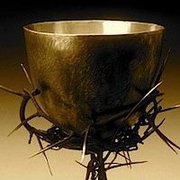
Mahaney wrote, “(Jesus) has every right to turn His tearful eyes toward you and me and shout, ‘This is your cup. You’re responsible for this. It’s your sin! You drink it’.” **

And suddenly I couldn’t get low enough before the Lord. There was no other place to go but flat on the floor, face to the carpet, wailing in grief and shame. “I’m responsible!” I cried, tears and snot smearing on the rug. “I’m the sinner!” And for the first time my heart grasped the magnitude of what Jesus did to allow me the privilege of calling his Father my Father, too.

Because Jesus drank every poisonous drop of the cup of God’s wrath, I will never have to take even one small sip… because there’s nothing left in the cup.

“You see, at just the right time, when we were still powerless, Christ died for the ungodly.” (Romans 5:8)

*p. 81   **p. 82

Were you there?

Tonight our church conducted something called “The Stations of the Cross.” Growing up, I’d never heard of this tradition, but apparently it originated in the Catholic Church. During Easter week, parishioners walk Jesus’ path toward the crucifixion, praying through each stage of his dreadful journey. The point is to ponder Christ’s suffering and death, appreciating it anew. Our initial prayer tonight was, “Let me see what once you did for love of me and all the world.”

I overheard one attendee said, “Isn’t this a Catholic thing?”

But another said, “Yes, and we grew up thinking we shouldn’t do it because they did.”

We were given a booklet listing 14 stopping points throughout the church, each with a suggested prayer and an opportunity to participate in Jesus’ experience.

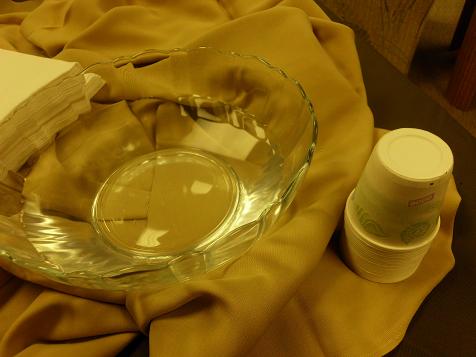
At Station 1 we found a bowl of water representing Pilate washing his hands of Jesus, along with a gavel we could bring down in judgment representing the mob that unjustly condemned him.

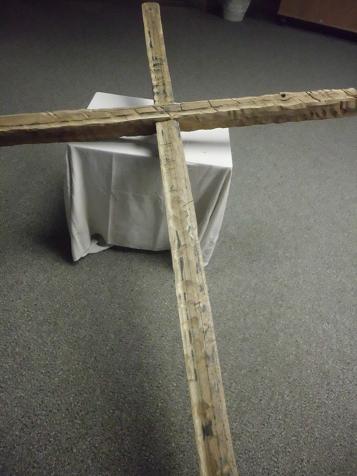
At Station 2 we were invited to lift a heavy wooden cross as we thought about Jesus carrying that burden on his flogged and bleeding back. It symbolized the weight of our sins, so heavy they crushed him completely.

We were encouraged to choose a large, dirty rock and feel its weight, then write one of our sins on it and throw it into a garbage can, receiving forgiveness and leaving sin behind.

There was a station representing the love of Jesus’ mother and his love for her, expressed on the cross. Another station urged us to accept a small handkerchief as a symbol of the comfort so many in this world need but don’t receive, just as Jesus needed comfort on his painful journey. As Christians we ought to provide that comfort, even for someone who’s been disfigured and might be covered with spit, blood and sweat as Jesus was.

On we walked through each station, arriving at Station 8 where we approached a bowl of salty water representing Christ’s tears. If we so desired, we could taste them from a cup, sharing a tiny bit in his suffering. We were reminded of Psalm 126:5, “When we sow with tears, we’ll reap with songs of joy.”

We meditated in front of clothes representing Christ’s stripping and humiliation for us and prayed for a willingness to be stripped of whatever hinders our full submission to him – possessions, affections, addictions.

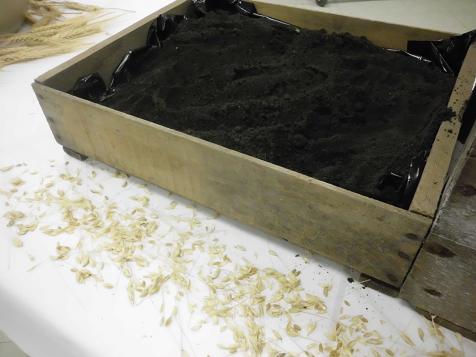
At Station 11 we planted wheat seeds in rich, black earth and meditated on John 12:24: “Unless a kernel of wheat falls to the ground and dies, it remains only a single seed. But if it dies, it produces many seeds.” Jesus spoke these words in reference to his own impending death.

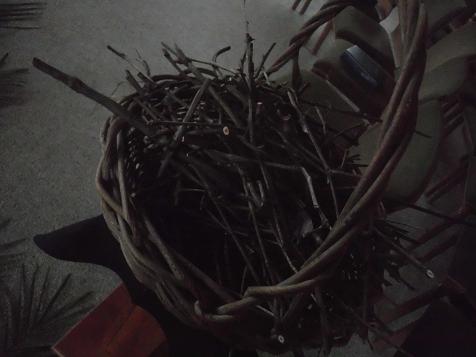
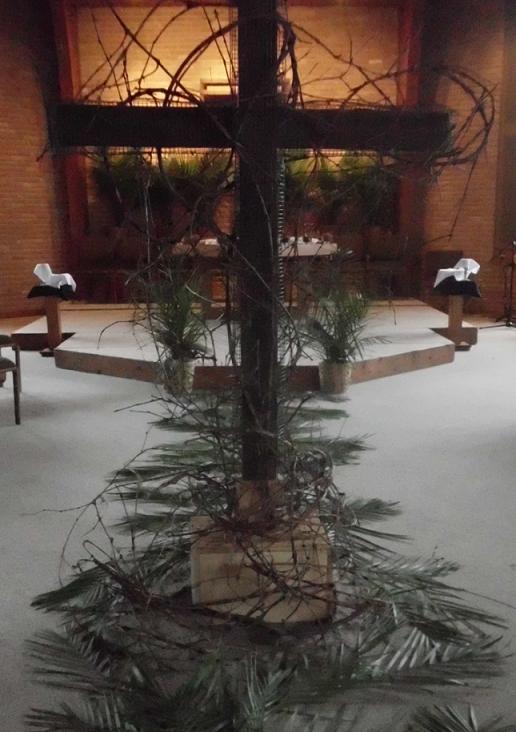
As we approached a full-sized, vine-wrapped cross at Station 12, we put dead branches onto it, symbolizing Jesus’ death. By this time I was feeling cold and shaky with a deep sadness from head to toe. Holding back tears was difficult, but Station 13 was harder yet.

Spread on the sanctuary communion table was a flax colored cloth (behind the cross) representing the removal of Jesus’ body and preparation for burial. Beside the cloth were bowls of sweet-scented spices. Something about touching that cloth made his death poignantly real for me, and the tears spilled. “I’m so sorry,” I whispered.

The last station found each of us sitting alone in the dimly-lit sanctuary while solemn music played, all of us in one-on-one conversation with the Savior. My little white hankie from Station 6 came in handy!

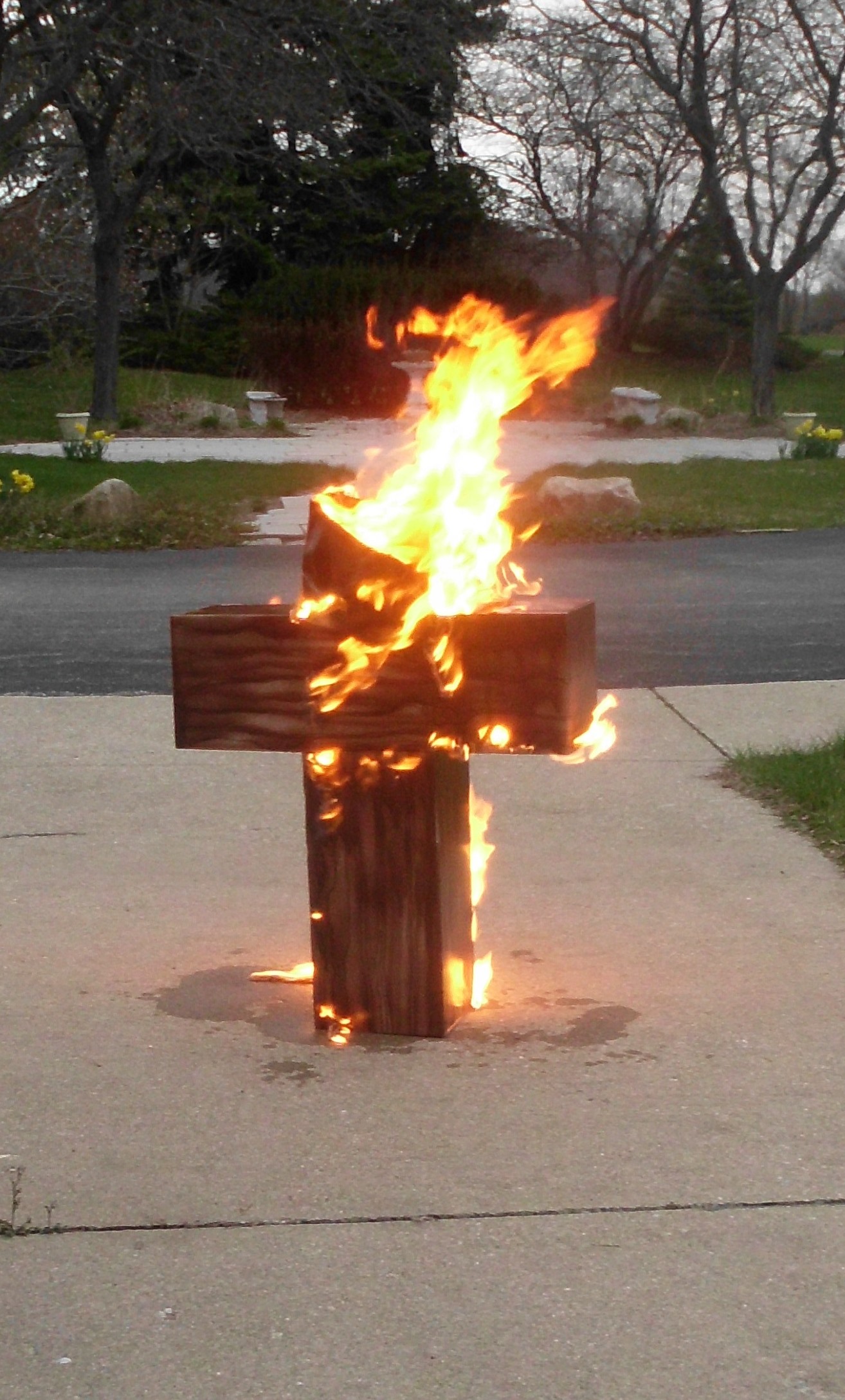
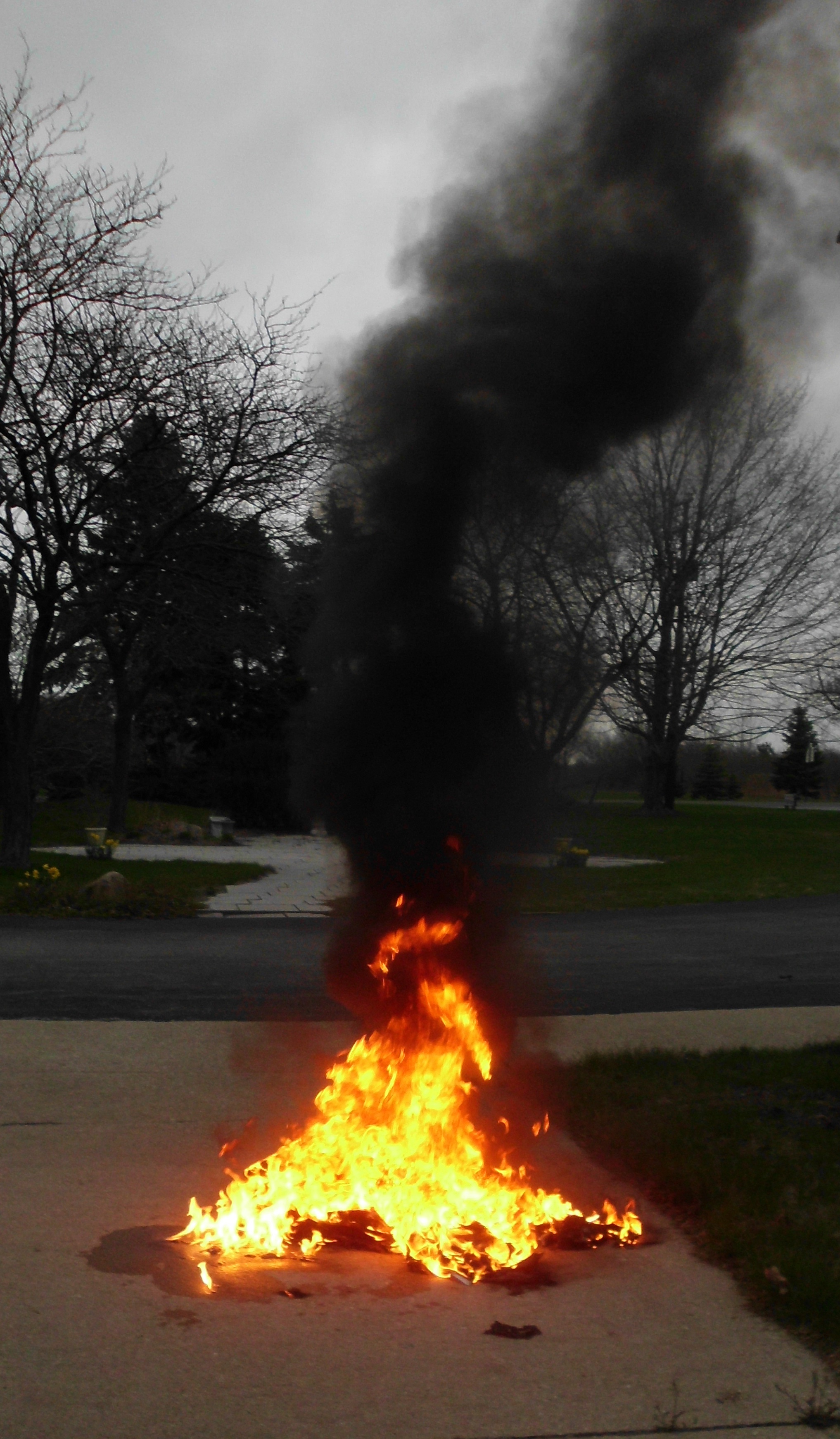
After sharing communion together, we went outdoors where a dramatic scene ended the evening. At one of the stations we’d been invited to leave our burdens at the cross by writing them on small cards and putting them inside a cardboard cross. The cross was now set on fire, and our burdens were lifted heavenward by the flames.

“When they had crucified him… they kept watch over him there. Above his head they placed the written charge against him: THIS IS JESUS, THE KING OF THE JEWS.” (Matthew 27:35-37)