Toxic Fun

This evening as we were busy preparing an early supper for our two little ones and a later one for the rest of us, one year old Micah was hungry and fussy. As several of us chopped vegetables and cubed cheese, Micah burrowed between our legs and into the cabinet beneath the kitchen sink.

Tugging on my pants he reached his pudgy arms up to hand me something saying, “Deet-doo,” his version of “thank you.” He gave me the spray bottle of Windex, then waited for me to parrot his words.

“Thank you, Micah,” I said, putting the Windex on the counter.

Then he proceeded to hand me the bleach spray, the dishwashing liquid, furniture polish, flea spray, plant fertilizer and floor wax, each one with a “deet-doo.” None of it was appropriate for toddler play, but we were busy, and his cabinet clean-out was keeping him out of our hair.

Of course we were monitoring his potentially harmful playtime, but it made me wonder how many toxins we, as adults, “play” with while not being monitored. Toying with drugs (I’ll just try it once) or alcohol (Everyone drinks) or shoplifting (They charge too much anyway) or smoking (It looks cool) or any number of other toxic habits can ruin us before we even know what happened.

Another subtle poison that can ruin us is playing around with truth, stretching it here, subtracting from it there. Thankfully, God is monitoring that, since he has the corner on truth, and Jesus personifies it. He has a vested interest in what we do with it and him. We’re to “buy it” exactly as Scripture presents it.

If we aren’t sure how to handle it, God will counsel us. A good prayer from Psalm 25 is, “Guide me in your truth and teach me, for you are God my Savior.” When we dabble in his truth by choosing only the parts that appeal while setting the rest aside, this habit gradually becomes toxic and leads us to a deadly end.

If little Micah could have opened the cleaning products that looked so attractive to him, he would have spilled them on himself, tasted them, rubbed them in his eyes. While he was stinging with pain, he would have wondered how something so pretty could have hurt so much.

We ought to wonder the same thing before opening the cabinet door on hazardous behavior. “If I start this, will I be able to stop?” Sometimes God stops us, but he’s been known to let us have our way, too, which usually includes suffering the natural consequences of playing with poison. Under-the-sink liquids might require a bit of Ipecac, but altering truth will lead to harsher penalties.

Maybe the best approach is the one Micah used. Hand it off to someone responsible and say, “Deet-doo…  but no deets.”

“Buy the truth and do not sell it — wisdom, instruction and insight as well.” (Proverbs 23:23)

Look over here!

Spending time with babies and preschoolers reminds me how easily distracted they are. Micah, at 18 months, can be hard-core tantrumming about a toy he hopes to snatch from his sister but a quick glance at something new turns it off like a water faucet. His lilting voice returns, and he’s all grins.

Tonight he was cheerfully munching his dinner when he accidentally knocked his plastic plate to the floor, scattering its contents in a yard-wide circle. Jack was there in a flash, demolishing Micah’s meal in less than a minute while Micah wailed and pointed at the tile in anguish. Although he loves Jack, it was disturbing to see his ham rolls and cheese cubes disappear.

There was no calming him. Dinner was over.

I took him out of his high chair in an inconsolable state, but by the time we’d walked to the next room, he was belly-laughing. The only thing I did was bump my forehead against his and say, “Buh buh buh buh.” Distractibility. It’s a wonderful thing.

Or is it?

Being that distractible is associated with being immature, but I wonder how many of us with accumulated years are equally as distractible. From God’s perspective it must seem continual. We join a Bible study but get distracted while doing our lesson and arrive unprepared. We promise to memorize Scripture but fail to focus and can’t retain what we learn. We vow to do better at sharing our faith but get sidetracked worrying about failure. We commit to regular offering contributions but get diverted by a vacation package or a new car.

I wonder if God doesn’t long to see unswerving determination in our spiritual lives. Paul talks about “fixing our eyes on Jesus” as we run life’s race, explaining how not to become distracted along the way. James describes the negatives of being “double-minded.” And in Deuteronomy we read God’s urgings to obey “without turning to the right or to the left.”

Scripture links distractibility not only with immaturity but also with instability, and none of us wants to be unstable. If we can resolve to be single-minded, we’ll eliminate quite a few problems. For example, if married people refuse to entertain ideas of being single again, fewer will walk away from their spouses. And if we commit to living in harmony with others, the courts won’t be as overloaded as they are.

The benefits will be personal, too. If we follow through on saving money, we won’t panic when an emergency occurs. If we commit to eating wisely, we’ll be healthier. If we take God’s promises at face value, we’ll live in freedom.

The temptation “to have our cake and eat it too” is all around us, and if the enemy can keep us distracted and lock us into wishy-washy thinking, he knows he’ll be victorious.

If only it were as easy as “buh buh buh buh.”

“A double minded man is unstable in all his ways.” (James 1:8)

Getting Old

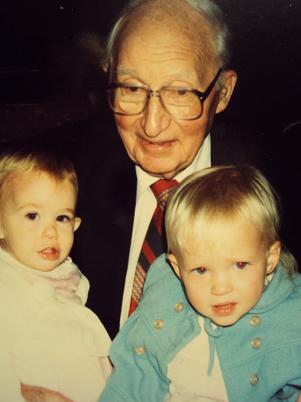
My folks were married 50 years and 1 month before Dad died after a fall, at 92. Mom was only 79 at the time, 13 years his junior.

Although 13 years is a big gap between husband and wife, we kids thought nothing of it, because Mom and Dad made it work well. I remember only one incident, one comment, when their age spread surfaced. It occurred a few months before Dad died.

After they had spent an evening at our house, the two of them were walking toward the front door. Suddenly Mom, who adored Dad, said, “Carl, don’t shuffle. You’re walking like an old man.” (He was 92.)

In a way it was a compliment. She was saying, “I don’t think of you as an old man, so don’t act like one.”

After her comment, Dad picked up his feet, a compliment to her. He was saying, “I’m glad you think I’m still spry.”

Interestingly, after Dad died, Mom lived 13 more years, so God gave her the chance to know 92 as he had. Her conclusion? “Now I know why Dad shuffled,” she said. “He wanted to be sure he didn’t fall.”

With age comes wisdom, but sadly, while we’re young, we rarely value it and don’t often ask advice of our elders. All of us need to know the difference between being worldly wise and spiritually wise. I’ll take the latter, any day. Though the world reveres youth and sets the aged “out to pasture,” God thinks quite differently. He tells us in Scripture we’re to stand in the presence of the elderly and to always show them respect. Then he links both of those to revering him.

He put old people in important roles throughout the Bible and in doing so, highlighted their accomplishments for all time. But what were those accomplishments? Each one dealt with kingdom business, the stuff of eternity.

The world prizes financial wealth, political power, external beauty, physical strength, all of which will one day disappear. God values the things that last: sacrificial giving, humble hearts, godly character, faithfulness to him.

Elderly Christians shine in these ways, which is why the Lord allows them to flourish spiritually, even while they’re declining physically. It behooves us to get close to these people and glean all we can before they’re taken from us. And if you have trouble identifying who they are, just watch for a walk that’s more like a shuffle. It’s a sure clue wisdom resides within.

“The righteous… will still bear fruit in old age; they will stay fresh and green, proclaiming, ‘The Lord is upright; he is my Rock’.” (Psalm 92:14,15)