
Look and See

Many of us learned to read by way of the “Dick and Jane” readers, starring Mother, Father, Dick, Jane and Sally. Spot the dog and Puff the cat also featured into the plots.

Each page was three-fourths picture and one-fourth text. “See Spot. See Spot run. Run, run run.” I grew to love this family that was similar to ours, a boy and two girls, a dog that looked like Spot, and a cat named (yes) Puff. Virtually all American children in public grade schools learned to read with Dick and Jane, from the 1930’s to the 1970’s.

When I remember these books, the words “look” and “see” come to mind. The author hoped children would look at the world around them and observe all there was to see, learning life lessons while learning to read. But there were problems.

For one thing, all the characters were white, and their looking and seeing was all from that one perspective. Ethnic children didn’t relate to Dick, Jane and Sally. Their viewpoint was different and needed to factor into the stories. In the 1960’s, the books were finally expanded to include families of other races, which brought a richer depth to plot lines for all children.

Sometimes I wonder how differently I would see life had I been raised in a different country or been born to another race or faith. But this is an imponderable. We are who we are and have a limited perspective based on what we’ve looked at and seen.

Wise people expand their vision outside their experience with a desire to see beyond their own worlds. This can be really difficult, but there is a looking and seeing that’s easy to practice.
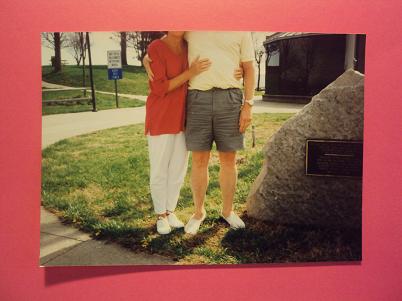
This picture of Nate and me was snapped before digitals (1985) by an eager little boy who had begged to take charge of the camera. We posed, and he centered the shot perfectly. Had he turned the camera or taken one step back, the result would have been different.

I decided to keep it, though. Even without any heads, the picture tells a story. The arms and hands say something, as well as the clothes, the plaque on the rock, the summer day, the long shadows. Had faces been visible, the other parts of the story might not have been noticed. It’s simply a picture from a fresh perspective.

God’s desire is that we look and see from his fresh perspective. This includes the way we look at circumstances and people, and especially the way we see him. In order to change our perspective, we have to look at how Jesus viewed circumstances, people and his Father, then copy him. None of that comes easily and takes years of practice, but as we try, we’ll see with new eyes.

The demise of Dick and Jane came in the 1970’s as phonics became the standard for teaching reading. But when we hear someone say, “See Spot run!” we know exactly what they mean.

Look up, and be alert to what is going on around Christ—that’s where the action is. See things from his perspective.” (Colossians 3:2 The Message)

Taking the Lead

Last week I enjoyed writing about my mom and her mom, thankful for the upright heritage they (and others) left. Judging by worldly standards, Mom was an old lady of 92 who never worked outside her home or accomplished anything of note. Strangers might have said, “Hers was a wasted life.”

But those of us who knew her, know otherwise. Before Mom died, we used to joke she’d have a big funeral, and we were right. The crowds came in droves, filling the large room where her body lay, spilling out into the halls and out the front door.

The funeral director came running to us just before the service began with alarm on his face. Distressed that not everyone had a seat or had even gotten into the room he said, “Why didn’t you tell me!”

What he meant was, “Why didn’t you tell me this woman was popular? We don’t usually see this for old ladies like her!”

As we greeted guests, Mary and I noticed how most were from the generations behind Mom, people our age and younger. These were the “children” she’d loved and influenced throughout her life, loving all of them as her own. Rather than wasting her life, she’d used it for lofty purposes, leaving footprints that led them all to Jesus.

Here’s an important question for each of us still marching along on this side of our funerals: “Where will my footprints lead?”

Steve Green’s song “Find Us Faithful” says,

“As those who’ve gone before us,
Let us leave to those behind us
The heritage of faithfulness passed on through godly lives.”

God gives us a simple but effective way to leave footprints others will find it worthwhile to follow: just track the steps of Jesus.

In Mom’s last year of life, she continually had her nose in a Bible. One day I asked if she’d looked at the biography of Julia Child I’d just given her, or her new book about hymn authors. She said, “Honey, I don’t have any time for those. I’m studying for my finals.”

Despite not owning a trophy case or being written up in periodicals, Mom finished well.

“After all our hopes and dreams have come and gone
And our children sift through all we’ve left behind,
May the clues that they discover and the memories they uncover
Become the light that leads them to the road we each must find.”
(Steve Green)

“God called you to do good, even if it means suffering, just as Christ suffered for you. He is your example, and you must follow in his steps.” (1 Peter 2:21)


The Footprints We Leave

Singer Steve Green wrote a song that speaks of the generation before us living high-road examples of faith:

Those who’ve gone before us line the way,
Cheering on the faithful, encouraging the weary,
Their lives a stirring testament to God’s sustaining grace.

I look back to my four grandparents, and although three of them had “gone” before I was born, they left footprints of lives that were “stirring testaments to God’s grace.” Each of them lived through severe hardship, yet letters we found were proof of strong relationships with the Lord.

The one grandparent I did know, my mother’s mother Signa, died when I was three. I have only a handful of memories, but she did two significant things for me. She raised my mom, and she was a faithful witness for Christ.

Signa came to America from Sweden as a young girl and married a widower whose 26 year old wife had died of pneumonia leaving him with a baby boy. Signa saw a need and stepped in to help when little Everett was 3, marrying into motherhood in 1908.

After Signa and Ed had been married 5 years, Everett died in a school yard accident, crushed by a heavy iron gate that fell off its hinges. At that time, Signa had given her husband three additional children that were ages 4, 2, and 1. A 4th and 5th child would follow. But death struck a second blow when another son died at 6 months.

Our Mom remembered standing next to her father as this baby brother died in his arms. Overcome with sorrow, Signa had left the room, unable to bear the sight of a second child passing away.

Signa struggled with asthma most of her life, necessitating leaving smoky Chicago during summer’s heat. Her husband, together with 5 other men, bought a cottage in Michigan, and as school let out, Signa left for “the country.” She took her brood of 5 and also the 6 children of a widowed relative. Without benefit of electricity or running water, Signa cared for 11 children by herself from Memorial Day to Labor Day.

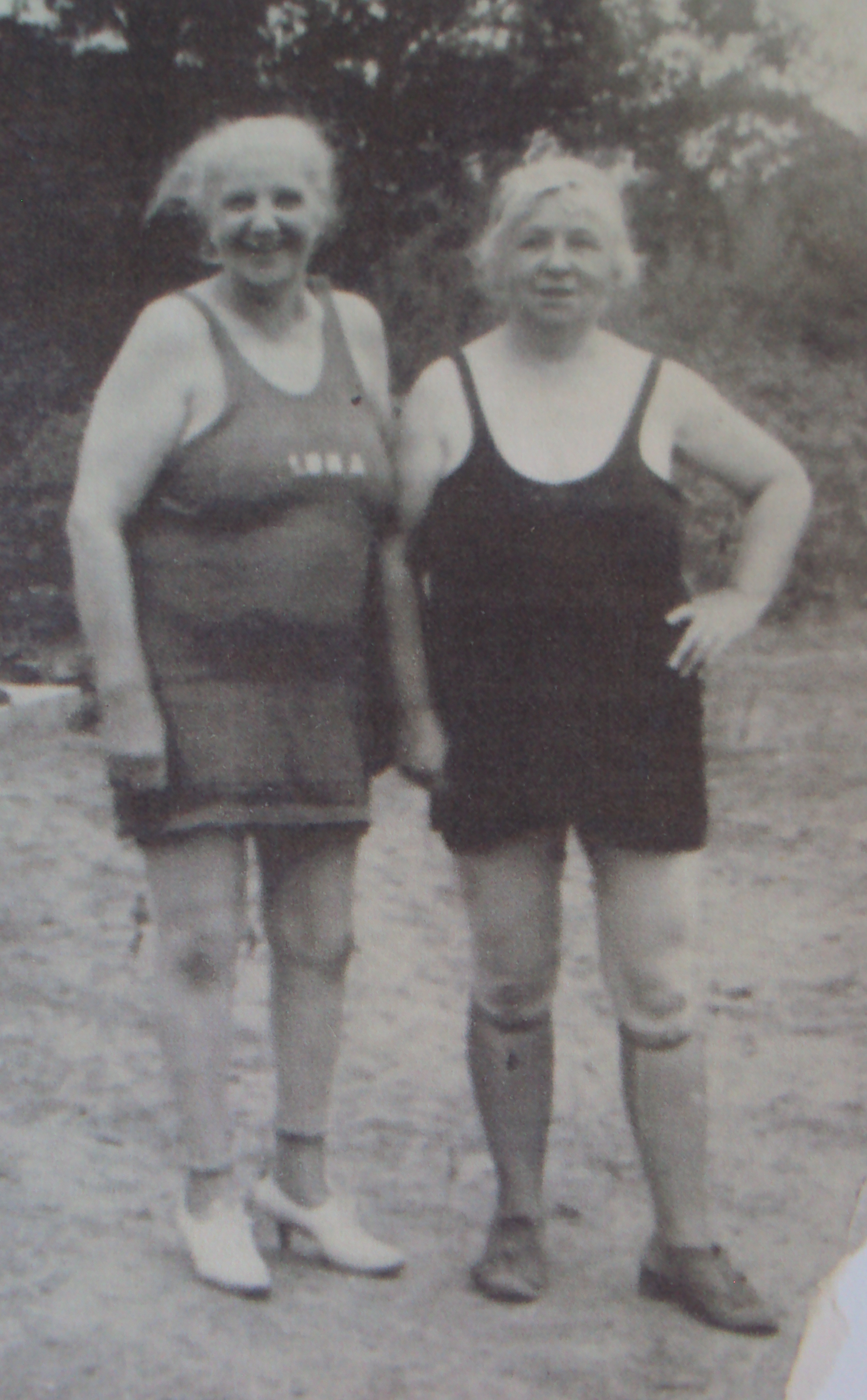
When school resumed, she shipped the children home to her husband and stayed alone in Michigan until the first frost. No doubt this was a nourishing time for her, and the photo shows a worn-out but joyful Signa (on the right) enjoying a day at the beach with a friend.

Signa dealt with the stranglehold of the Great Depression, her husband’s diabetes, and eventually his terminal cancer. She was also concerned over one of her children who was epileptic, keeping her “at home” throughout her life. Signa died in her sleep at age 69, her faith in tact and her witness strong.


The chorus of Steve Green’s song could very well have been Signa’s prayer for the generations to follow:

Oh may all who come behind us find us faithful.
May the fire of our devotion light their way.
May the footprints that we leave
Lead them to believe
And the lives we live inspire them to obey.

Signa was quietly remarkable, and I hope she knows the footprints she left have indeed inspired us. That’s because the steps she followed were those of God.

“I’ve followed [the Lord] closely, my feet in his footprints, not once swerving from his way.” (Job 23:11)