Three Wise Advisors

I was born to a wise father. He was “seasoned” when he married at 42 and up to that point had lived a life of integrity while overcoming obstacles. Age plus integrity plus overcoming equals wisdom.

Dad told us he never thought he’d live long enough to see his children graduate from high school, much less college. Children-in-law and grandchildren were off his radar, yet God blessed him with 92 years of near-perfect health and sound thinking. He saw his kids graduate from college, marry and deliver 15 of 17 grandchildren. Not bad for a late bloomer born in 1899.

Dad loved learning, and no subject was off limits. Coupled with a sharp memory, his accumulated knowledge was formidable. An architect and structural engineer by day, he became my high school math tutor by night. I struggled with algebra to the point of tears, which is when I’d look for Dad, knowing he’d never refuse to help me.

His tutoring, however, was torture. Approaching him for one quick answer, my heart would sink as I watched him thumb backwards through the textbook to “see where you’ve been.” He’d get so enamored with the numbers it took 20 minutes just to get back to the current assignment. And as with all wise people, he wouldn’t give out answers. Instead he tried to increase my understanding, and beyond that, to drag me into a happy relationship with math. (Negative on both counts.)

But oh, how I admired Dad. He wasn’t emotional like I was and didn’t burst into tears when life became overwhelming. He tackled problems methodically, demonstrating a skill that was foreign to me. When I needed wise guidelines for choosing a husband, Dad was ready and actually had a list: 1) Christian beliefs, 2) a sense of humor, 3) good health, 4) respect of family, 5) love of children. In the end, I married a man who passed muster on all five points. As a matter of fact, the man I chose was much like Dad.
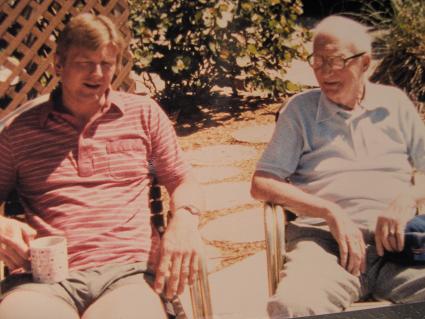
Although I never had to solve another algebra problem after marrying, I often went to Nate for his opinion on other matters. He was endlessly patient and, just like Dad, would never turn me away. He often thought about our discussions long after they were over, coming up with additional possibilities days later. With all he had to worry about in the business world, I considered that to be true love.

When Nate died, death muzzled him. Although I have his past counsel and can guess how he might advise me about new dilemmas, the absence of his opinion is one of my greatest losses. As with most couples, we were opposites, and contemplating his flip side to my viewpoint always tempered what I would do next. His words coaxed me to think out of my box and gave me a level head.

Sometimes when I asked Nate for counsel, his advice was so far from my opinion, I struggled to believe that following it would be wise. But I’d remember that in the Lord’s couple-economy, the man was given headship and would, as a result of this God-established order, be given God’s wisdom, which he would then pass on to me.

If I followed Nate’s recommendation even when it seemed contrary to my own, things often turned out well. Knowing God protects and nurtures what he’s established, this shouldn’t have surprised me.

When Nate got cancer, I stopped asking for his opinion four weeks into the six he had left. The disease had begun superimposing its influence over his ideas, and I never knew which voice was talking. Thankfully I’m surrounded by other wise guides who’ve stepped willingly into the counselor role for me, again and again.

And at the top of them all is the Lord himself, our “wonderful Counselor.” (Isaiah 9:6) He’s already been my caring Father and heavenly Husband, so I have every reason to believe he’ll come through as my proficient Advisor in days to come. And just like Dad and Nate, I know he will never turn me away.

All that the Father gives me will come to me, and the one who comes to me I will certainly not cast out. For I have come down from heaven, not to do my own will, but the will of him who sent me.” (John 6: 37-38)

Lessons According to Hyacinth

I’ve always loved the BBC comedy show “Keeping Up Appearances.” In the Chicago area, it played at 7:30 pm every Saturday night. My mom also loved this program, especially the hilarious character at the center of every episode, Hyacinth Bucket, “…pronounced ‘Bou-quet’!”

For a year or so before Mom died, Nate graciously volunteered to eat Saturday evening dinners with his newspapers instead of his wife, letting me spend that weekly time with Mom in her apartment. I made dinner for the three of us, then packed up two plates to take to Mom’s, leaving Nate’s with him.

Every week Mom and I eagerly anticipated Saturday’s dinner-date with each other and “our Hyacinth”, laughing together over her misguided efforts to keep up with the Joneses and hopefully surpass them. If there was anything redeeming about that show, it was learning how not to act, but Mom and I had a delightful time watching Hyacinth scheme and dream.

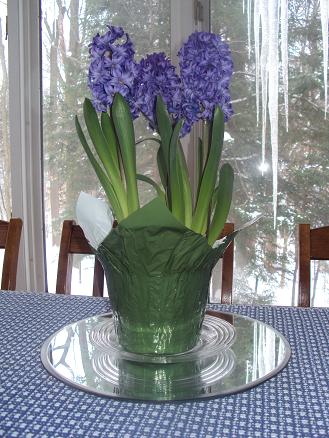
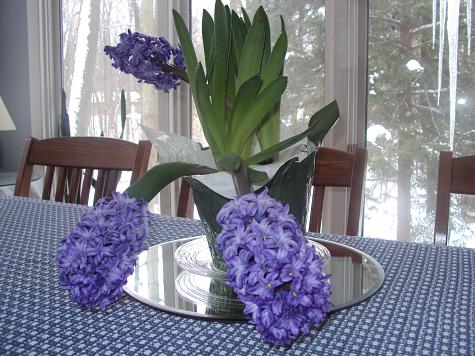
As for Hyacinth’s name sake, a colorful spring bulb-flower, they’ve always been my favorites. Last Saturday Mary stepped into our door carrying a pot full of them, three hyacinths just on the verge of bursting into bloom. This early preview of spring would soon give off a rich perfume strong enough to fill the room. Even with my damaged olfactory nerves, I could smell trace amounts of their powerful scent, a rare treat.

This morning when I came downstairs, all three blooms had opened to-the-max. They were so lush and heavy, their stems were bent sideways. I rushed over and buried my nose in them, enjoying a spring moment in the middle of January, courtesy of my thoughtful sister.

Standing back to admire the hyacinths, I could see they needed more support than their hollow stems were offering. It was a picture of how I felt on many mornings, too, hollow and heavy. Finding an old garden stake in the basement corner, I snapped it in three pieces and gave them the support they needed. Problem solved.

It got me thinking about my situation. What is my garden stake?

I didn’t have to think long. The number one thing shoring me up when I’ve felt limp and low has been prayer, especially prayer that includes the words of Scripture. Praying by using verses of the Bible is my fail-safe way to claim the support and vigor God offers. On a really burdensome day, I can put my name right into the passage as I pray it. God doesn’t mind. After all, his promises are for each of us personally.

Praying through 1 Peter 5:7-9 has encouraged me today: “I’m casting all my worries and concerns on you, Lord, because you promise you’ll care for me. I’m asking you to keep me alert to the evil you tell me is prowling around like a wild animal. The devil wants to spoil my reliance on you as I try to get through this grief. Strengthen me to resist him and stand firm in my faith, knowing many others who trust you through tough times are doing exactly that, all over the world.”

The vivid word pictures of Scripture are helpful. Even today God delivered a fresh visual, the drooping hyacinths, to link me with the practical power in that 1 Peter passage. God was following through on his promise to care for me, reminding me of his provision within each day.

Although television’s Hyacinth demonstrated what not to do, nature’s hyacinth taught me to stay close to the strong stake of scriptural prayer. The results are more satisfying than even the best episode of “Keeping Up Appearances.”

“Three times I pleaded with the Lord about this [grief or pain], that it should leave me. But he said to me, ‘My grace is sufficient for you, for my power is made perfect in weakness.’ Therefore I will boast all the more gladly of my weaknesses, so that the power of Christ may rest upon me. For the sake of Christ, then, I am content with weaknesses… hardships… and calamities, for when I am weak, then I am strong.” (2 Corinthians 12:8-10)

A Wavy Day

Recently I met with a friend who I hadn’t seen since before Nate’s cancer. After we shared a hello and a hug, she said, “Well, I sure can see this whole thing has taken a big toll on you.”

I think she meant I looked worn and haggard. That’s certainly how I felt. Ongoing grief is exhausting. Just when you think the worst is over, a new wave of sadness washes over you like an icy dousing without warning. It’s similar to watching a sand castle get swamped when a wave rolls past its natural boundary and overwhelms it.

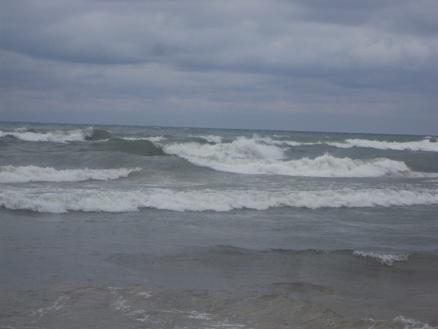
The interesting thing about waves of grief is that they’re much like waves of water. They rush in, but they also rush out again, usually fairly quickly. I think of the fun of a wavy day at the beach when we were kids and how we bobbed on the surface, using the waves to our advantage, until a big one crashed overhead. Then it was tumble and toss, often with water going up our noses, until we could get our footing again and come up for air.

Waves of grief are much like that. We’re moving through a day successfully when unexpectedly a wave knocks us down and floods us with tears. That happened to me today as I sat at the dining room table writing a few notes. I was answering a letter in which a friend had written, “We want to continue getting together with you,” and all of a sudden I was crying. A picture of the four of us came to mind, engaged in lively conversation, except that it was only three of us, a sad scene I couldn’t bear.

My crying lasted about three minutes. I had to get up to find some Kleenex but shortly after that was back finishing the note. A wave had broken over me but had quickly receded, just like at the beach.

God separated the dry land from the sea at creation, defining the boundaries of the waves, and he separates waves of grief from those who mourn, defining those boundaries as well. In both cases, he lets the waves come, but it’s “this far and no farther” as he controls their power.

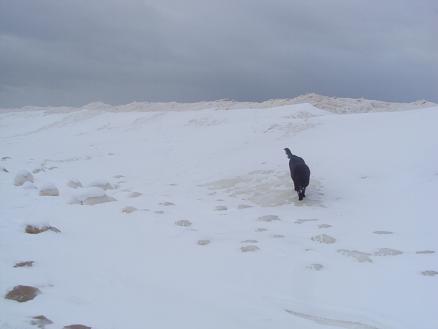
An interesting thing has happened to the waves of Lake Michigan this week. With the colder temperatures, water that has splashed up on the snow-covered beach has frozen into lumps of sandy ice. Each wave has added another layer to the lump until mounds of ice have grown too high to see over. Climbing up the slick hills is nearly impossible with regular snow boots. Jack has an advantage with his claws, but even he slips and slides backwards now and then.

The mounds of ice continue to grow in height. Wild waves hit the icy ridge with a crash so powerful it causes water to splash ten feet into the air, landing atop the hill and rapidly freezing, thus adding new height. Unlike summertime waves that roll up and quickly fall back, these waves rise and freeze, one atop another.

Grief is like that, too. If we hold back the tears and don’t allow ourselves to experience the sadness, grief freezes inside of us, building layer upon layer until it becomes a mountain beyond which we can’t see. It’s much better to let it surge up, come out in tears and then recede.

When I break down and have to stop what I’m doing to be sad for a few minutes, I ought to also be glad, knowing God’s healing is in process. He’s keeping a watchful eye on those waves, and when they wash up too far or come too close together, he moves in to force them back. If I let them come flowing out in tears, they’ll never be able to freeze up (and mound up) deep inside.

You [Lord] rule over the surging sea; when its waves mount up, you still them.” (Psalm 89:9)

“I [declares the Lord] made the sand a boundary for the sea, an everlasting barrier it cannot cross. The waves may roll, but they cannot prevail; they may roar, but they cannot cross it.” (Jeremiah 5:22)