Overloaded

Today while running errands I was waiting at a light when a spectacular semi-truck turned in front of me. It had more tires than I’d ever seen on one vehicle, all doubles, 4 to an axle except on the cab. As it drove past, I counted: 36 wheels.
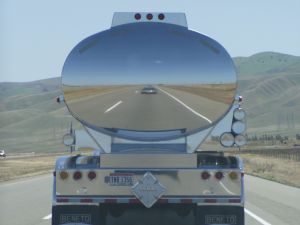
All I could think of was how difficult it must be to keep that many tires in good shape simultaneously. Are they wearing properly and balanced correctly? Are their lug nuts snug? Rotating tires must be a nightmare similar to playing Mancala with game pieces too heavy to lift.

Why so many wheels?  The answer is, tons of weight inside.

It made me think of all the excess weight we carry, not in pounds but in burdens. Trouble comes when we try to carry too much on only 2 wheels.

This morning in Bible study we were in Exodus, reading how Moses was trying to lead a million obstreperous people through miserable circumstances. He was doing the best he could, but it wasn’t good enough. He didn’t have enough wheels to hold up his heavy load, and it was ruining him.
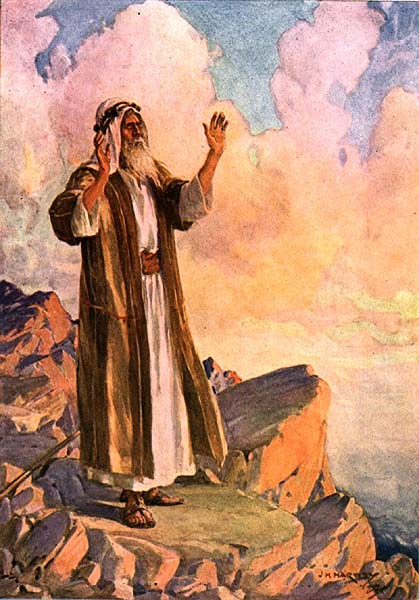
God saw the problem and brought Moses’ father-in-law, Jethro, to the massive Israelite camp at exactly the right time. In learning how burdened Moses was he said, “The work is too heavy for you; you cannot handle it alone.” (Exodus 18:18)

So God planted a fresh idea in Jethro’s mind, and Jethro passed it along to Moses. The heavy weight was quickly redistributed to helper-judges, which gave Moses the 36 wheels he needed to continue moving the massive group forward.

Years later he again found himself weighed down by the impossible burden of his role. The people were crushing him with their complaints, so once again he went to God. “I cannot carry all these people by myself; the burden is too heavy for me.” (Numbers 11:14) It was time for a new set of tires. God provided them again in the form of many able helpers, and Moses’ load was lifted.

What about our 21st century loads? More often than not we take on impossible weight, dragging under the heavy burden while trying to give the impression we’re living feather-light. When others see us bent beneath our loads and ask if they can help, we say, ”No thanks,” not wanting to add to their loads. But as we learned in Bible study this morning, if we accept the help of others, a blessing comes to them as well as to us.

Moses modeled what to do when we’re overloaded. Step 1: ask God to lighten it up. Step 2: listen for how. We’re to avoid the extremes of either asking no one, or asking many of the wrong ones, because our best burden-lifter will always be God.

Praise be to the Lord, to God our Savior, who daily bears our burdens.” (Psalm 68:19)
Story Time

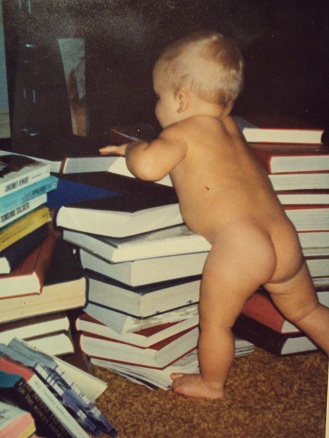
Our daughter Linnea and son Hans, both busy young parents, share a love of books. These days, however, their personal reading time is at a premium since their collective offspring are ages 3, 2, 1, 1, and 1 (with another non-reader arriving in February). But Linnea (with Adam) and Hans (with Katy) try to share their love of books with their children by way of daily story times.

Nate, too, was intentional in his efforts to transfer his passion for reading to his 7 children, purchasing a giant book of classic fairy tales while I was still pregnant with our first. This book was a hardbound volume weighing 5 pounds that was full of tiny print, not exactly the stereotypical children’s book. (I favored plasticized board books with which our baby could simultaneously get educated and cut teeth.)

After Nelson arrived, Nate made good on his intentions and began reading to him nightly. One day, 3 weeks into parenthood, he said, “Do you think it’s too soon to introduce poetry?” I laughed but had to admire his gusto.

Toting his 5 pound volume around the house, Nate took advantage of multiple opportunities to read to his drooling audience of one. Thanks to him, by the time baby #2 came along, we’d gotten into a happy bedtime routine of stories, songs and prayers that continued until the kids were teenagers, much like many families we know.

Today I look at my bookshelves, pared down by two-thirds when we moved, and at least one-third of the books are still for children. I’ve hung onto them partly to read to grandkids but partly just because they’re comfortable old friends.

God was the originator of words and stories, and he has filled Scripture with them. Over the years we’ve learned much of what we know about him through the stories he’s given us. Also included in the Bible are the stories of people who rejected him, and we’ve learned from those, too.

Parents begin story time with a question: “What would you like to read?”

God also points to his stories with a question: “Which do you believe?”

All of us buy children’s books with care, wanting a measure of control over what goes into young minds. The volumes that make it onto our shelves have been screened so that any choice a child makes is a good one.

But there’s one big difference between that and God’s story time. Parents have already made the acceptable choices before their children approach the shelf. God opens the whole library and says, “The choice is up to you.”

“This is what the Lord, the God of Israel, says: ‘Write in a book all the words I have spoken to you.’ ” (Jeremiah 30:2) “Every word of God is flawless; he is a shield to those who take refuge in him.” (Proverbs 30:5)

“May God go with you.” (…continued)

As Thelma and I slowly continued on up the paved dune searching for Jack, she began telling stories. “I’ve rescued a lot of dogs from shelters. Most of ‘em look pretty good after a thorough scrubbing.”

Although we didn’t see Jack, we did see the car he’d followed, parked in front of one of the high-up cottages. If we couldn’t find him, I would double back and check there.

Continuing around several curves, we began moving down and eventually came to the spot where Jack had become confused. There he was, standing in the rain as if to say, “I was here. Where were you?”

Panting from his long loop up the road and down again, he gratefully hopped into the back seat, immediately leaning forward to get sniff-acquainted with Thelma. His tail wagged enthusiastically, and reaching back to pat his head, she said, “I told you. Dogs love me.”

Heading out of the subdivision, I listened to her describe how she liked helping people clean up their yards, saying it took her many sessions to complete one. “You gotta work on ‘em slow and steady. There’s too many leaves for one time.” She listed the names of those she’d already raked, and I recognized many of them.

Driving out into the country I said, “You’ll have to tell me which way to go.”

“Just keep on goin’,” she said, pointing out the front windshield.

Sure enough, about 6 miles inland from Lake Michigan she finally said, “There,” pointing to a small wooden house. “That’s where I live.”

As she got out of the car I rolled down the window, letting the rain pour in. She thanked me and nodded toward the house. “It’s adequate. More important, it was built with love. God has always taken good care of me.”

She patted the wet car as she walked alongside it, probably for support, and then turned around and said, “God go with you.”

I waited in the driveway to be sure she would get in, but she was playing a waiting game, too, making sure I backed out safely. As we both looked at each other, her hand on the doorknob and mine on the steering wheel, it was as if God said, “I love Thelma. Make sure you do, too.”

Eventually I waved through my open window and backed away, praying the prayer I so often pray: “Lord, what do you want me to think about all this?”

And he gave me this thought: “Think about how Thelma trusts me to take care of her. Today I coaxed Jack to follow the wrong car so I could give her a ride home. Without him running off, you wouldn’t have seen her. I set it up for her, and lucky you. You got to deliver it.”

Then he said something else. “See how I care for Thelma? I’ll always do the same for you.”

The Lord said, “I have loved you with an everlasting love; I have drawn you with unfailing kindness.” (Jeremiah 31:3)