
A Worthwhile Harvest

Nate died 25 months ago, but his influence continues on. This will be true for all of us. The seeds sown into others’ lives keep on taking root, blossoming and bearing fruit, whether good or bad. All of us are given a lifetime of days during which to do our farming, and it’s up to us what we plant.

Jesus told a fascinating story about seeds. He describes an industrious farmer who worked hard planting a big field, after which he went to bed satisfied with his effort. While he was sleeping, though, his enemy quietly moved in and planted weed-seeds among the wheat.

As the good plants began peeking above the soil, the bad ones did, too, and the wise farmer recognized the subversive work of an adversary. Once the plants were growing together, there wasn’t much he could do, but at harvest time, with extra effort, he solved the dilemma.

By that time the weeds were easy to separate from the wheat, probably because they were taller. Weeds always seem to grow bigger and quicker than the more valuable plants. The farmer had the weeds pulled first, bundling and burning them, followed by the wheat that had been left standing. It was hard work, but in the end he got the cash crop he’d originally planted.

This afternoon I found fresh evidence of Nate’s profitable farming. I opened one of our many Bibles to check a passage and noticed his handwriting in the front. He’d been planting heart-seeds in one of his children who was leaving home for college, gifting him with a Bible and words of affirmation on the flyleaf:
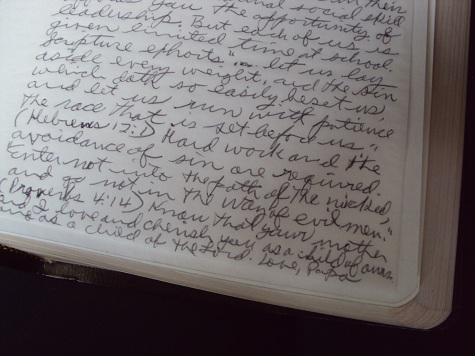
 “As your father, I’ve noticed your ability to befriend others with ease; of kindness and patience with small children; of self-confidence and grace with your peers.”

He went on to challenge him to use college years to develop the talents God had given him. Then he wrote, “Your abilities can be used to worship God and also to lead others to Christ and to make the right choices in their lives.” He continued, quoting from his favorite Scripture passage, giving his son a heads-up about avoiding sin.

In concluding he wrote, “Know that your mother and I love and cherish you as a child of ours and as a child of the Lord. Love, Papa.”

Nate was planting good seeds, regardless of the enemy’s desire to mix bad in with the his good. Reading the words he wrote challenged me to keep farming, despite unwittingly planting bad seeds among the good. According to Scripture, the harvest can be 100 times what was sown, which makes it doubly important to “plant positive.”

But the scriptural parable can encourage even those of us who occasionally mess up, telling us that all it takes is one good seed to bring a magnificent crop.

“Though it is the smallest of all seeds, yet when it grows, it is the largest of garden plants and becomes a tree.” (Matthew 13:32)

Up and Out

Nine days ago I was working at the computer one night when I heard a strange scratching in the kitchen. It sounded like a giant mouse running around in a cabinet. When I went to investigate, I realized whatever it was was running around in the small cupboard above the stove. I didn’t dare open the door.

That cabinet had been a rodent residence before, until I got around to buying mouse poison. But knowing this one probably squeezed in through the fan vent made me hope he might depart the same way.

The next morning it was quiet, but I bought some D-Con poison to put in the cabinet anyway, just in case. The morning after that I checked the poison, and the industrial-sized rodent had returned, had eaten most of the cardboard boxes and also what was inside them.

I closed the door and decided to let nature take its course.

But night after night the scratching returned, 8 evenings in a row. This was one resistant mouse! Then yesterday morning I opened the cabinet and shrieked. Lying down, pressed between the cabinet door and my cookbooks, was a BIG something! In a nano-second I slammed the cabinet shut and wondered what it was! Surely it wasn’t a 9” long mouse! Maybe a rat?

I decided not to open the cabinet again, worrying he might fly out at my face and bite me with his poison-drenched teeth. But later when Mary came, we cracked it open to take a peek. He was still lying there but had changed his position.

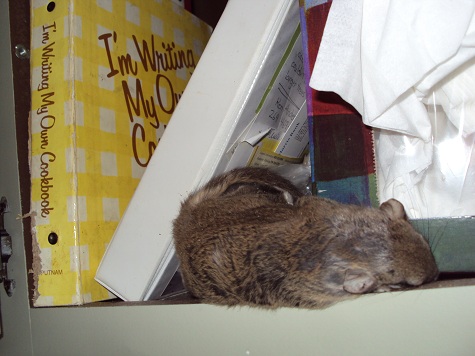
Not knowing what to do, we did nothing. I rubberband-ed the cabinet closed, and we decided to sleep on it. When we carefully opened the door today, we got our first good look at him. A baby squirrel! I felt awful. Why would a baby squirrel be running around in winter weather?

He had died, but probably died happy. Three boxes of palette-pleasing poison were completely gone. No doubt he’d looked forward to his special end-of-the-day treat every evening.

“Well,” I said, searching for a silver lining, “at least he won’t have to struggle through a cold winter.”

Sometimes I think that same silver lining applies to people, too. God removes someone from this troubled world, taking them to heaven, and we wonder why a life was “cut short.” Could it be he wanted to spare them from a “cold winter?” That’s a question to which we’ll get an answer only in eternity.

I do know in Nate’s case that he’ll never have to struggle with the winter of old age or die in the cold reality of a long, drawn-out illness. Being spared of those is blessing indeed. But even better than that is his new life of “joy unspeakable and full of glory.” (1 Peter 1:8)

It’s already begun!

“Good people pass away; the godly often die before their time. No one seems to understand that God is protecting them from the evil to come.” (Isaiah 57:1)

What good will it do?

One of life’s great privileges is being able to talk to the Almighty. After reading the Old Testament and seeing how he kept a distance between himself and people to the point of causing whole mountains to shake, it’s astounding he allows us to approach him at all. He not only allows it, he encourages it, warmly inviting us to come into his throne room. He even suggests we “come boldly,” bringing requests. What changed from Old Testament to New?

Jesus came, that’s what.

As we celebrate his arrival again this Christmas, we’re conscious of the extraordinary benefits made available to us by his coming, but there’s none greater than being given access to the Father, Son and Holy Spirit. It’s free to us, but certainly wasn’t to Jesus, who paid our entrance fee.

One of my great joys during the last 20 years has been to sit with others for extended times in the throne room. This week while meeting with 4 women to pray over a list of requests given to us by the church and individuals, a spirit of discouragement flooded through me. As we got ready to pray, we divided up the long list into 5 parts, one for each of us to cover out loud while the others prayed silently. We do it this way each week, but for some reason this time I felt swamped by all the requests. There were 83 in all, many of which had 2-3 sub-requests within them.

How could we pray for them all in the 90 minutes available?

As the first woman began praying, my mind stayed stuck in the enormity of our task. My head was bowed, but my eyes weren’t closed. They were reading the list: physical maladies, emotional crises, relationship divisions, financial struggles. On and on it went. How could our little band of 5 accomplish anything significant for these hundreds of needy people?

My desire to converse with God was plummeting, but his desire to talk to me was still strong. And talk he did: “Do you think your invitation into my throne room is so you can show me what you can do for these folks? Or is it for Me to show you what I can do?”

And that’s all it took to pull me into the conversation.

I’m thankful for the reminder that prayer is all about God, not me. My part is just to approach him with confidence, believing he hears and answers the requests I bring. And sometimes he does it well before reaching #83 on the list: “Before they call I will answer; while they are still speaking I will hear.” (Isaiah 65:24)

“Let us then approach God’s throne of grace with confidence, so that we may receive mercy and find grace to help us in our time of need.” (Hebrews 4:16)