Rules of the Game

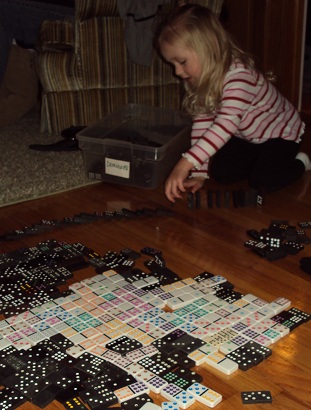
Although Skylar and Micah are gone now, happy reminders of their visit are everywhere. At one point last week we brought out a bin of jumbled dominoes, some black, others brown, still others with colored dots, and one ivory-white set.

As I tried to teach her how to play authentic dominoes, she added her own creative flare to the game by filling in every available space between tiles. We ended up with less of a dotty road and more of a domino doormat. Showing her how to stand them up and watch them fall in succession was frustrating when her line kept falling ahead of schedule, so Skylar pursued her other ideas.

 

She transformed the dominoes into little houses, then into people who talked back and forth. She used them as blocks and also separated them into like categories. One morning I came downstairs to find she’d carefully placed the white dominoes atop the white piano keys. Who needs domino rules with so many other ways to play with them?

Many of us adults have a similar bent toward creative game-playing, although with us it might be interpreted as “ditch the rules and do it my way.” Sometimes we approach God like that, acknowledging his Rule Book and how he wants us to play the game of life but then making a case for personal creativity so we can side-step him. So, how much creativity is too much? Is there any wiggle room with God?

He gives us 66 books detailing how best to live our lives. Then he says, “You can do it in many specific ways, and each life will look different. Be creative! There’s just one condition: stay within my protective perimeters.”

It’s that last part that gets to us, producing streaks of rebellion we hope God will see as creativity. But when he says “don’t” he means, “Don’t hurt yourself by disobeying me.” Along with his don’ts, he usually says, “If you do it your way instead of mine, here’s what your self-wounding will look like.” But when our creative juices get flowing and our own ideas seem superior to his rules, we often can’t help ourselves.

Thankfully, though, natural consequences are an effective teacher. With enough self-inflicted pain, we eventually understand that God wrote the rule book the way he did for reasons that would benefit us.

As for Skylar, ultimately we had to put an end to her creativity. Using the dominoes like missiles was a no-go. Through natural consequences (the dominoes going back to the basement) she learned creativity can, indeed, go too far.

“Make a careful exploration of who you are and the work you have been given, and then sink yourself into that. Don’t be impressed with yourself. Don’t compare yourself with others. Each of you must take responsibility for doing the creative best you can with your own life.” (Galatians 6:4, The Message)

A Familiar Prompt

Two years ago, when I was a new widow, Sundays were the most difficult day of every week. Apparently this isn’t uncommon for a woman who’s lost her husband, since he was the one she’d spent every Sunday with, from sharing a hymnal, to a brunch after church, through an afternoon nap.

In the beginning I couldn’t sit in a service without tears and usually had to make use of the two tissues in my pocket. Just seeing a couple seated side-by-side in the congregation was enough to produce a wave of distress. If the husband put his arm around his wife or took her hand, it was over for me. These simple gestures were poignant reminders of what I’d lost, and it took over a year to become sorrow-free in church again.

During this second year, however, attending church hasn’t been nearly as difficult. To the contrary, it’s been a blessing. This morning, though, without warning, something popped me back to that first year. All it took was seeing a man’s wedding band.

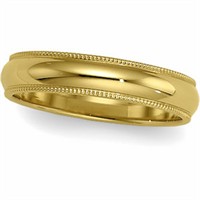
He was sitting in front of me and had his arm over the back of his daughter’s chair. His ring was identical to Nate’s with milgrain-style edging. I focused on that ring and thought of Nate’s wedding band hanging on a gold chain in my bedroom at home. It was on a necklace only because it had been taken off his hand before we buried him, but it was never meant to be jewelry for me.

Many young grooms opt out of wedding bands these days, but Nate was delighted to wear his. The day in 1969 when I put it on his finger was, he told me, one of his lifetime highlights. He was glad to display his ring as a sign that he was married and never tired of talking about his family.

No marriage is without its difficult places, though. Often couples are taken by surprise with the tough stuff that comes along: career disappointments, accidents, bone-deep fatigue, physical handicaps, parenting challenges, unexpected deaths, money shortages, severe illness. Any one of these can swamp a couple.

God explained his purpose for marriage when he said it wasn’t good for people to spend too much time alone, but marriage isn’t always easy. His idea was that there be two people bonded in a show of togetherness that could defend their union against any common enemy, no matter what it was. In other words, “Whatever has threatened you has threatened me, too, and we’ll fight it together.” As Mom used to say, shared burdens are cut in half.

This morning, my glimpse of a stranger’s wedding band brought a jumble of thoughts as I sat in church missing Nate. But tears didn’t factor in. While staring at that familiar-looking wedding ring, I felt God prompting me toward gratitude, because Nate had been the one who saw to it that we made it through even the hard times.

“Though one may be overpowered, two can defend themselves.” (Ecclesiastes 4:12a)


Perfect Protection

We’ve all heard the rumor that a thriving population of alligators lives in the New York sewer system. That became popular in the 1950’s when local dime stores like Woolworths and Ben Franklins sold baby alligators as pets.

Actually Nate bought one of them as a school boy, bringing it home for his mother’s approval. He guessed she wouldn’t let him keep it, and after several days she did march him and his reptile back to the store for a refund. Other ‘gator owners chose to slip them down gutter drains or into sewer pipes when they grew too big to keep, which is how the sewer rumors got started.

As Nate matured, he learned how dangerous alligators could be and realized why his mother hadn’t let him keep his ‘gator when he’d pleaded to do so. She was simply protecting him from harm.

Do we ever take time to look back on the protective parenting God has done for us? If we do, we’ll notice how often he saves us from dangerous situations by overriding our poor decisions with his better alternatives. I remember one dramatic example of this as a college freshman. My roommate and I, part of a choir tour, were given one free evening to roam in a big university town.

The two of us chose to wander around the massive campus and went into the student union, looking for fun. Tacked on the bulletin board was a 3×5 card: “Party tonight in [dorm name], room 245.”

That sounded good to us, two sheltered 18 year olds without a shred of street smarts. We asked other students the way to the dorm and quickly found ourselves locked in a room with a group of rowdy boys already well-fueled on alcohol. The “party” wasn’t what we’d envisioned, and it became obvious the two of us were going to be the meat on the menu.

It’s a long story, but the bottom line was that God provided a way out, and we bolted away unscathed. Though we’d been sure of ourselves going in, the Lord knew better and saved us from our own stupidity. Looking back, we can see the recklessness of that night and are thankful for God’s intervention.

But what about those times when he doesn’t save, when he doesn’t prevent the accident or doesn’t heal the cancer? In Nate’s case, he chose not to stop a disease from taking him. Can we look back and see God’s protection? Gradually we’re gaining that exact perspective and are understanding that he did protect Nate… from having to live with debilitating pain and a slow deterioration. He also protected the rest of us from having to share in that.

But what about those cases where we look back and still can’t see how God protected? Can we trust that he did?

We can, for one good reason: his Son asked him to do so. Jesus prayed,

“Holy Father, protect them by the power of your name.” (John 17:11)

And God has been doing it ever since.