Starting Small

We’ve all heard the expression, “A journey of 1000 miles begins with a single step.”

This weekend we enjoyed a beautiful snowstorm, and as with the first small step of a journey, that blizzard began with one small snowflake. Mary and I were outside when she spotted a flake in the air and said, “Is it snowing?”

I didn’t see anything and said, “I don’t think so.”
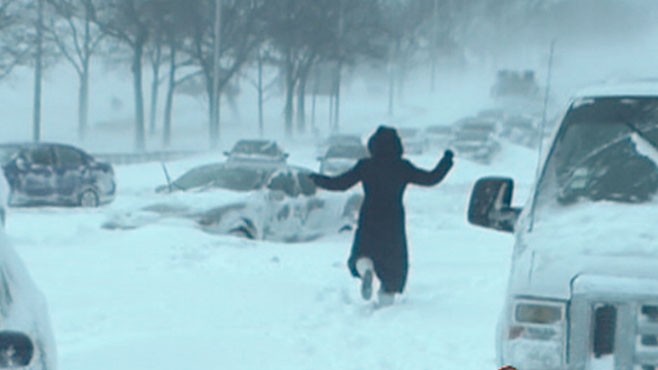
But soon there was one more and then another, and sure enough, millions followed. Insignificant beginnings can reach sizable proportions and end up having considerable influence. Our weekend blizzard got so severe it completely shut down the highways at the southern end of Lake Michigan, bringing everybody’s car to a standstill for hours. And it all began with one snowflake.

Many of life’s important events start just like that, so small they go unnoticed. Take Noah’s flood. That global calamity of mountain-deep water began with one raindrop. In other categories, a college degree begins with one class; a 50 year marriage begins with one vow; a skyscraper begins with one cornerstone; a marathon begins with one stride; and a human life begins with one cell.

Even the creation of God’s Universe began with one word.

But unlike our small steps, all power was embodied in that first word, as it is in all of God’s words, more power than even a category 5 hurricane. And even hurricane power is minor compared to what’s behind every one of God’s words. Were we to thoroughly understand how vast this power is and what he can do with it, we wouldn’t have the courage to get out of bed in the morning.

But interestingly, God says his power “is made perfect in weakness.” In other words, we’re not to stress about how powerful he is. Instead we’re to believe him when he offers to use bits of it for good in our weak lives.

In trying to understand this better, I thought about a gigantic, powerful horse. I pictured him rearing on his hind legs, muscles rippling, head shaking, mane flying, people backing away from such dominant power. Then I pictured that same horse on another day, standing calmly in his corral while a toddler wanders toward him. The massive horse leans low and lightly touches his soft muzzle to the child’s cheek, his muscles relaxed, his power in check.

Although this is an inadequate picture of God’s power and his command over it, it does help me understand a little. He’s willing to control his infinite power enough to participate in our small beginnings. He can gently touch our lives in ways that will, with enough touches, eventually revolutionize us. It’s much like the first step on a long journey or the first snowflake in a big blizzard.

One step with him can grow into thousands. And that life journey is one I want to take.

“The gospel… is the power of God that brings salvation to everyone who believes.” (Romans 1:16)
Out from under Regret

Virtually every widow struggles with regret. She’s haunted by the many ways she could have been a better wife and thinks, “I should have… I wish… If only…”

When I think of my own marriage, one thing Nate modeled exceptionally well was his consistency in thanking me. There were other things in his life he struggled to be grateful for, but I wasn’t one of them. If I filled his drawer with clean underwear, he’d find me and let me know how much he appreciated it. If I brought his dry cleaning home, he’d thank me for taking such good care of him. And though I made simple dinners, he never ate one of them without voicing gratitude.

Some wives might have found this over-the-top, but it always felt good to me. My regret is not having done the same for him. I should have daily thanked him for battling it out at work. I could have mentioned his kindness each time he filled my car with gas or willingly picked up our children at odd hours.

Interestingly, I often had thankful thoughts toward Nate but over and over failed to transform those into audible words. In each case, then, the only one benefitting was me.

All of us can recall situations in which we liked what people did, what they said, or what they looked like, but didn’t deliver the compliment or word of appreciation. We thought it, but didn’t speak it out.

The biblical book of James says our tongues can be used for good or evil, to soothe or irritate. There’s a No Man’s Land in the middle, though, that he doesn’t mention, words in our heads that have the power to bless others but never make it to our tongues.

But we’re not left without instruction on this. God sees our wordless thoughts and says, “I the Lord search the heart and examine the mind, to reward each person according to their conduct, according to what their deeds deserve.” (Jeremiah 17:10)

He’s saying, “I’m looking for those affirmative thoughts you have toward others and will bless you if you voice them. When you speak goodness over someone else, I classify that as a deed worthy of reward. If you hold it in, you not only haven’t blessed others, you’ve also forfeited a blessing for yourself.”

Since I’ve repeatedly fallen short on this, my response to God’s statement is to admit failure and ask for help. Hopefully he’ll pluck thankful words from my brain and set them on my tongue, moving in with his supernatural controls. Because he is able when I am not, I know it can be done.

And while I’m trying to remember to say good things to others, I can practice by verbalizing words of praise to God.

“All kinds of animals, birds, reptiles and sea creatures are being tamed and have been tamed by mankind, but no human being can tame the tongue.” (James 3:7,8)

By my own self!

When our firstborn was a 20 month old toddler, his favorite sentence was, “By my own self!” That’s not really a sentence, since there’s no subject or verb, but we all knew the subject was “Nelson” and the verb was “do!” He desperately wanted to be independent.

Two weeks ago when I was in England visiting my 3 young grandchildren, the twins evidenced that same indomitable spirit at 22 months saying, “Own! Own! Own!”

I looked at their mommy and said, “What does that mean?”

“They want to do it ‘on their own’,” she said.

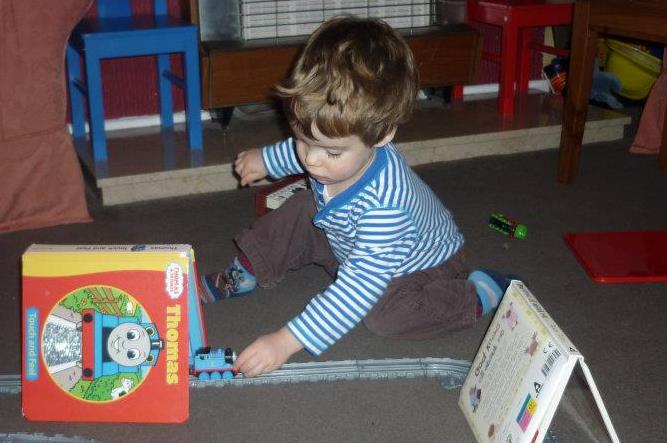
If I began peeling an orange for Evelyn, she’d reach for it and shout, “Own! Own!” Or with Thomas, I’d start to set up a train track and he’d say the same. “Own!”

Every child has their uniique way of communicating the same message: “Me have it!” or “I wanna do it!” or just plain “Nooo!”

As soon as children have minimal vocabulary, what they most want to say with it is, “I’m independent!” They’re letting us know they don’t want or need any help.

We laugh at that since most of the things they’re trying to do are beyond their toddler capabilities. But don’t we adults often communicate the very same message to God? We know he wants us to humble ourselves and come to him for help, but first choice is always to do it “by my own self.” When we finally admit we need him, our request still comes out wrong: “Lord, help me to do such and such.”

Instead it ought to be, “Do whatever you want, Lord, and I’ll follow.”

We live in a world that idolizes self-rule, which is one reason why following Jesus is so unpopular.  The backbone of Christianity is complete dependency on God, and the Bible’s steady drumbeat is, “Lose yourself in Christ’s sufficiency, and your life will have purpose.”

Making Christianity even less appealing to the masses, Scripture tells us our present life is only a training ground for life after death. We’re supposed to accept the old adage, “You can’t take it with you,” focusing away from earthly accumulation and toward heavenly treasure.

So how do we squelch the inner voice that begins talking to us at 20 months and never quits? How do we escape the natural human drive toward independence?

The only possible way is to admit that everything we do, have, or are belongs to God. That includes our homes and everything in them, our degrees, careers, accolades, investments, cars, our bodies and facial appearance, our health, our freedoms, even our children and grandchildren. All are God’s.

And once we acknowledge that, the rest comes easy, because if everything belongs to him, it’s only natural to follow his instructions on what to do with it all. As for doing anything “on our own” after that?

Not a chance.

“Anyone who loves their life will lose it, while anyone who hates their life in this world will keep it for eternal life.” (John 12:25)