Damage Control

Last weekend a bunch of us drove from our home in southwest Michigan to the Chicago area for a wedding. As we approached the city on the Dan Ryan Expressway, a disturbing sign caught my eye:

892 TRAFFIC DEATHS THIS YEAR      DRIVE NOW     TEXT LATER

Traffic deathsSurely all 892 weren’t killed as a result of texting, but some probably were. I know what it feels like to stray from my lane while texting and have done it just enough to say, “No more.” One second too many could exact a terrible price.

The other day Birgitta showed me an iPhone video taken through the front windshield of a squad car. An SUV in front of the policeman began drifting left. As it hit the shoulder, the driver must have looked up, recognized his error, and sharply overcompensated to the right.

He cut across several lanes and hit the side of a truck on the far right, bounced left across those same lanes and into oncoming traffic, and was hit head-on by a fast-moving 18-wheeler. The SUV and anyone inside were disintegrated on impact in an accident that took 5 seconds.

All of us are tempted to say, “I’ll just glance for a second.”

I wonder if similar life-devastation can happen when we look away from the Lord for “just a second.” The problem with texting while driving and also with taking our eyes off God probably isn’t as much about the quick look away as the getting stuck on what we’re looking at. Two seconds. Maybe three or four.

Whatever it is, it grabs our attention ever-so-slightly longer than the one second we promised ourselves. Suddenly we’re “stuck” and catastrophe occurs. It wouldn’t have happened at all except that whatever we were glancing at was, for those seconds, worth it to us.

The most devastating part of the whole thing is that there are no do-overs. If our quick peek turns into a longer one, it’s willful, risky, and a foolish gamble on our part. And if permanent damage gets done, whether while driving and texting, or in other areas of life when we let ourselves dwell on something we shouldn’t, back-peddling isn’t possible.

In hindsight, that just-a-second peek is virtually never worth it, because it doesn’t take much of a look to find us quickly invested in what we’re seeing. And when that happens, it gets more and more difficult to look back at God. As a matter of fact, it might be quite a while before we can pull our attention from what first distracted us to turn back toward him.

So hopefully, if we don’t text and drive, the odds are good we won’t be one of those numbers on Chicago’s expressway sign. Better than that, though, is not to take our eyes off God, not even for a second. If we focus exclusively on him, he’ll save us from many an accident.

“[Lord], turn my eyes from looking at worthless things; and give me life in Your ways.” (Psalm 119:37)

Our God of Grief

Scripture includes an interesting (and somewhat disturbing) verse I’ve always wondered about: “Though [the Lord] brings grief, he also shows compassion because of the greatness of his unfailing love.”  (Lamentations 3:32)

Most of us think of God as a grief-healer, not a grief-bringer. People have said to me, “The heartaches you’re experiencing have all filtered through God’s loving fingers.”

GrievingI can’t say those words have ever brought comfort, though they have spoken the truth. But that verse from Lamentations goes one step further than admitting our grieving comes to us filtered through God’s hands. It says that he sometimes brings it.

This is tough to swallow. Why would God do that? Why would he initiate grief?

Maybe the answer is in the second half of the verse where it says he shows compassion and has unfailing love toward us. The experience of grief feels more like being set out in the cold than being covered with compassion, but maybe God’s version of compassion somehow includes grief.

In the deepest part of my grieving for Nate, the tears and deep sobs that came out of me that first dark winter were, in a way, a strange kind of relief from the constant heartache. I’ve said many times in these blog posts that Nate never told me not to cry, because he believed each new cry let some of the sadness out.

I’ve heard the same thing from others since then, and I firmly believe it. During my first winter without Nate, I’d walk Jack around the neighborhood late at night and bawl almost uncontrollably. And 40 minutes later as we walked back into the house, me with mascara running and eyes swollen, I felt slightly better.

Maybe the Lamentations verse is trying to teach us that the whole process of grieving is God’s pressure valve for our hearts. Without experiencing the heartache, tears, sobbing, and moaning, we’d be so bottled up inside we’d practically burst. And thus the “unfailing love” part makes sense.

We get additional clues in the next verse: “[The Lord] does not enjoy hurting people or causing them sorrow.” The NIV says he doesn’t “willingly bring grief to anyone.” In other words, God wasn’t the one who willingly brought death, injury, disease, and dysfunction of all kinds into our world.

His original desire was that nothing about our lives would cause grief. But then sin entered, and all of the above grief-causers came with it. He needed a way to help us through, and the grieving process as we know it, is it.

I don’t think there’s any other way to interpret those two verses, because I truly believe God when he says he loves with unfailing love.

“Let the one who walks in the dark, who has no light, trust in the name of the LORD and rely on their God.” (Isa. 50:10)


Exactly Right

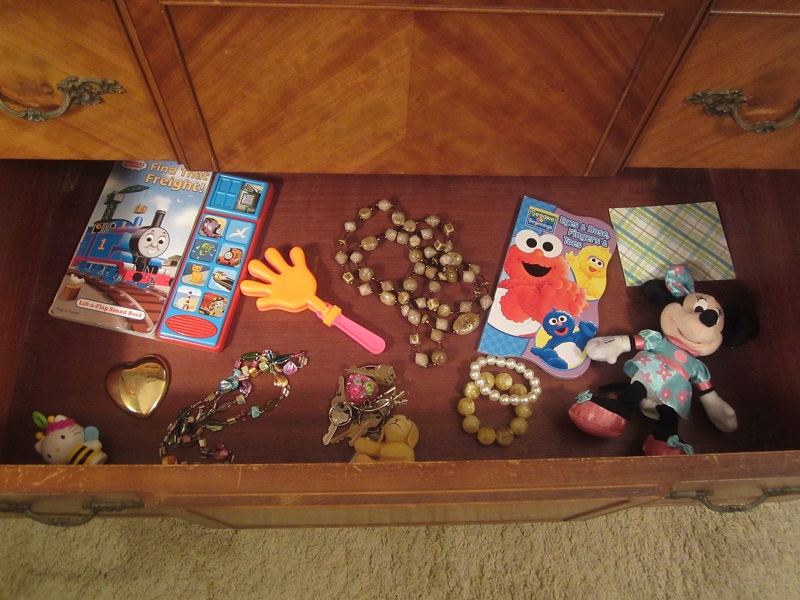
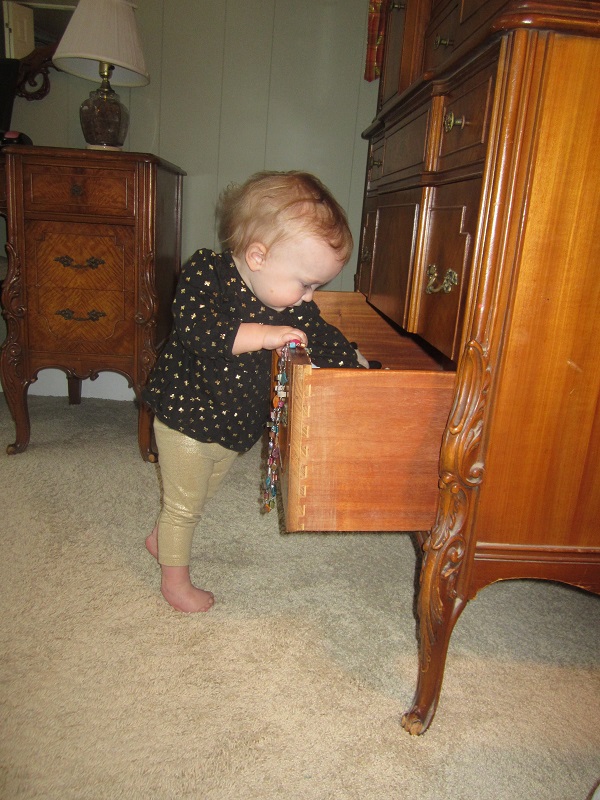
Once in a while Emerald comes upstairs to my room for a bit of play time, so I cleared out a bottom drawer and loaded it with toys she gets to play with only when she’s “visiting” me.

A drawer for EmeraldAlthough she loves the dozen or so items in the drawer, it isn’t long before she’s looking up at whatever I’m doing (with the hair dryer, a pen and paper, the computer), wanting to play with those instead. I could let her have her way, but I don’t, since she’d probably ruin those things.

When I tell her “no”, she gets frustrated and sometimes objects loudly. Of course she doesn’t understand, but I’m confident my reasoning is better than hers. So I try to re-interest her in “her” drawer, hoping she’ll be satisfied with toys appropriate to her age and abilities.

Maybe it’s oversimplification, but I think God hopes for something similar in his dealings with us. Though he showers daily blessings on all of us, they’re not the same for everyone. When I first set up Emerald’s drawer, I put some thought into which items I would include and chose only what I knew she’d love: books, stuffed animals, keys, costume jewelry.

The Lord knows (much better than we do) what will satisfy us. He chooses flawlessly and gives these gifts to us, then waits for a response of gratitude. But often we turn from those things and want what we can’t have, things he knows we aren’t capable of handling well. And it isn’t just material things.

We get frustrated when we can’t have certain talents or physical characteristics or opportunities. We see others who’ve been given these things and judge them to have better blessings than we do. Worse than that, we get upset if we can’t control our lives, our futures, in a way that belongs only to God. Then when we express annoyance with what he’s “put in our drawer,” we become a disappointment to him.

The perfect choicesAs Emerald plays downstairs with other toys, I watch her to see if something new or different might be a nice addition to her upstairs drawer, because it’s satisfying to see her play happily with the toys I’ve put in there. And maybe God finds the same deep satisfaction if he sees us enjoying the specific blessings he’s chosen for us. But if we’re always wanting something more or something different, we become a disappoint to him.

Although 13 month old Emerald has no understanding of disappointing me, I’m old enough to know better than to be greedy for more, or ungrateful for what I’ve already been given. And a good place to start breaking myself of such childish behavior is to thank him liberally for everything that he’s already put “into my drawer.”

“Let each person lead the life that the Lord has assigned to him, and to which God has called him.” (1 Corinthians 7:17)