
Forever?

Our P.O.My local post office is small and utterly charming, cute enough to be on a post card. Actually, I think it has been, having stood in the center of our tiny town for quite a few decades. The ladies who run it are charming too, always welcoming and always amiable.

Six years ago the United States Post Office issued the first “Forever Stamps.” They had a picture of the Liberty Bell on them and cost 41c apiece, which was the going rate for a first class letter then. The idea behind a Forever Stamp was that it wouldn’t matter when you’d use it; it would always be “good to go.”

First Forever StampI still have a few of those original Liberty Bell stamps in the zipper pocket of my wallet, the ones I paid 41c for. If I stuck one on a letter today, it would be worth 46c, the amount required for first class mail. That was the whole idea. Invest in Forever Stamps and watch their value escalate. Although it’s only pennies, we Americans like that kind of thing.

Of course these stamps aren’t literally good forever.

If something has the ability to last forever, that means it’ll have no end but will go on eternally, and there are precious few things on that list:

  • God the Father, Son, and Spirit
  • Human souls
  • Spirit beings, as created by God
  • Emotions (love, joy, peace, etc.)
  • God’s Word
  • The New Heaven and New Earth

Stamps aren’t on the list, and it’s good for us to recognize how many of life’s other “essentials” aren’t there either. Of course we have a practical need for stamps and lots of other things, but the trick is in prioritizing them all. Which items occupy the top few slots?

For those of us who care about eternity, the top slots ought to closely resemble the list above, and not just in a “don’t-I-wish!” category. Our priorities should be looking back at us from our day-timers, our check books, and our conversations. If not, we ought to ask, “Why not?”

The majority of our world would say, “Why bother with all that spiritual stuff?”  But that negates the unnumbered benefits of living a life submitted to God. And though I’m far from doing a good job of that, it’s worth a great deal to keep trying for even one glimpse of the Lord’s work in my life or in someone close to me.

Forever StampsBy the way, recently our post-mistress told me that all the stamps sold at post offices these days are Forever Stamps. I love that and sometimes buy hundreds at a time, hoping they’ll last past the next rate rise.

If I died tomorrow, though, of course I couldn’t take them with me. But heavenly communication surely won’t require stamps. Not even Forever Stamps.

“Surely goodness and mercy shall follow me all the days of my life, and I shall dwell in the house of the Lord forever.” (Psalm 23:6)


Smudgy Stains

Little Emerald is 11 months now, and though she can’t talk, she’s been communicating the same message since she began crawling a few weeks ago: “Clean your floors, Grandma Midgee.”

Taking advantage of her new mobility, she’s been investigating every corner of my cottage on hands and knees, a cleaning crew of one. But instead of swinging a broom or swiping a Swiffer, she just uses her clothes.

Dirty DudsThis morning while Birgitta was at school, Emerald and I worked on several projects in the basement. Although I sat her down next to a bin of toys, she quickly flipped to mobile-mode, resuming her floor-cleaning program. In just a few minutes her hands, knees and toes were black with who-knows-what, and at that point we abandoned the basement and headed upstairs to clean up.

Until Emerald began crawling, I had no idea my floors were as dirty as they were. It took “contaminating her” to let me know.

Isn’t that similar to what Jesus did for our filthy sins?

DarknessWhile on the cross, he willingly “crawled through” the sin-contamination of all mankind, letting every sin from every person, past, present and future, dirty him through and through. Scripture tells us he “became” our sin. How can we not sit up and take notice of how dirty he became, just so we wouldn’t have to be?

Then, after Jesus rose from the dead, everything changed. He conquered sin and therefore could become pure again himself, as he had been before he picked up all our filth. His suffering was “once for all,” after which he could freely offer an eternal clean slate to all of us.

So then why do we continue to suffer from guilt over our own sin? It’s because we’re shocked by  the blackness of it, just like I was surprised to see Emerald’s filthy clothes. But as we turn from our “dirty deeds” and ask forgiveness, recommitting ourselves to live for Christ, God no longer sees our dark smudges, all because of Jesus. Our sins have been deep-sixed into the sea, and we can enjoy release from the heavy darkness of guilt. What a beautiful cleansing system our Lord has!

  • I lay my sins on Jesus, the spotless Lamb of God;
  • He bears them all and frees us from every guilty load.
  • I bring my guilt to Jesus, to wash my crimson stains
  • White in His blood most precious, ‘til not a spot remains.

(Horatius Bonar)

I’ve made a concentrated effort to get the dirty stains out of Emerald’s pink clothes, but even my best scrub brush and a combination of chemicals have left telltale smudges related to the blackness that used to be.

How glorious that when Jesus goes about forgiving even the darkest of sins, he does it all the way to spotless.

“Come now, let us settle the matter,” says the Lord. “Though your sins are like scarlet, they shall be as white as snow.” (Isaiah 1:18)


I lay my sins on Jesus, the spotless Lamb of God;

He bears them all and frees us from every guilty load.

I bring my guilt to Jesus, to wash my crimson stains

White in His blood most precious, ‘til not a spot remains.

(Horatius Bonar)

Extravagant Giving

In a downpourI love the word “lavish”. Even the definition is fun to read: open-handed benevolence; giving in great amounts without limit; generosity occurring in profusion; abundance poured out.

The word originally comes from  Latin, lavare, which means “to wash, as in a downpour of rain.”

Although “lavish” is used in Scripture only a handful of times, God’s lavishness threads through the Bible in his actions. That’s still true today, and I’ve kept a journal detailing the lavish blessings he’s rained down on our family over the years, an effective antidote for any ingratitude that might creep in.

The road-map to God’s lavish provision often looks something like this:

  • A need appears.
  • We attempt to meet it.
  • Our attempts fail, and the need increases.
  • We try harder to meet it.
  • The need escalates to crisis level.
  • We realize we can’t meet it and turn to God for rescue.
  • He meets the need lavishly.

A perfect example took place when Nate was battling his cancer and fading fast. Our 7+2+2 children had come from far and wide to be with their father, all except Hans who lived with his family in England. Visa problems and UK re-entry issues made a trip to the States impossible. The story of God’s lavish provision is written up in a blog from that time. (Then God stepped in!)

It seems God relishes opportunities to pour “a profusion of generosity” on his children and is watching us for two things: a willingness to (1) trust him, and a determination to (2) wait for him. We say, “Oh, that’s easy!” when in reality the opposite is true. Both are difficult and take repeated practice.

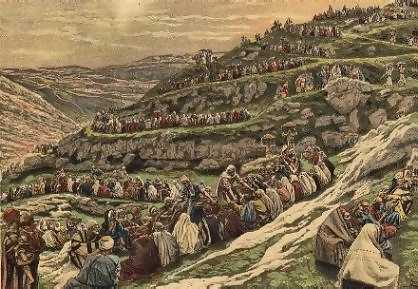
God knows we struggle to trust and then wait, so he details a variety of examples in his Word, showing how good it can be. One of these (taught in every Sunday School) is the feeding of the 5000. While growing up I viewed this as a nice miracle Jesus did so those he was teaching wouldn’t have to leave the meeting for dinner. Of course there was much more to it.

Feeding 5000+Just before that big picnic, Scripture tells us Jesus and the disciples had been so busy, they hadn’t even had time to eat. We don’t know how many meals they’d missed, but surely their stomachs were growling when Jesus suggested they separate themselves from the multitude so they could rest (and presumably eat). When the crowds continued to follow, their hope for rejuvenation evaporated.

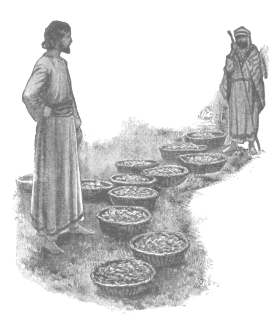
But fast-forward to the other end of the miraculous feeding that satisfied every appetite, and we see 12 full baskets of extra food, one per disciple. Jesus caused it to work out exactly that way (another miracle) not just to provide for their next meal. He wanted to use the leftovers to make an important point:

12 baskets of leftovers“Trust me with your needs, men; then wait expectantly, and I guarantee you’ll see what ‘lavish’ looks like, every time.”

“They all ate as much as they wanted, and afterward, the disciples picked up twelve baskets of leftover bread and fish.” (Mark 6:42-43)