Help for Beggars

We got an early start today, leaving Michigan well before sunrise. After dropping Nelson at O’Hare, Birgitta, Jack and I set off on a day of adventure, starting with a big Chicago breakfast. We worshiped at Moody Church, then headed for “The Magnificent Mile,” joining in with the shopper’s parade along beautiful Michigan Avenue.

As we walked, we were both disturbed to see beggars on every corner. Some were shaking cups of coins, calling to passers-by, while others barely peeked out from beneath their hoods or behind their signs. We saw men and women, young and old, and all were begging for money.

Literally hundreds of shoppers streamed past, ignoring the beggars and their pleas for help. As Birgitta and I shared a McDonald’s lunch, we tried to answer the many questions prompted by the presence of so many beggars. Were they hungry as their signs said? When did they last eat? Were they homeless? Where did they last sleep? Did they have families? How did they come to this?

As we talked, new questions arose. Would it be an insult to put only coins into their cups? And if we put money in one, shouldn’t we put it in all? Should we carry a roll of bills for this purpose? Would McDonald’s gift cards be better? Or maybe a scarf? A hat? Would a smile without a practical gift seem cavalier?
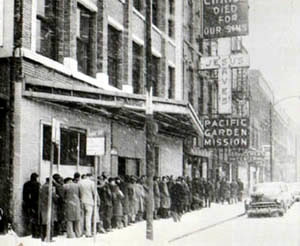
My dad served on the board of Pacific Garden Mission for several decades, believing in their work with the poor. He used to keep PGM business cards in his pocket for the homeless, telling them if they walked over to the mission, they’d receive a meal, a clean bed and whatever clothing they needed. Were these cards a blessing to the recipient or a disappointment?

After leaving Birgitta at Union Station to travel with hundreds of other students back to Iowa, I drove home to Michigan, bothered by what we’d seen today. I felt guilty for not having given of myself or my money. Although I had cards for “GettingThroughThis” in my pocket, they seemed inadequate for such severe problems.

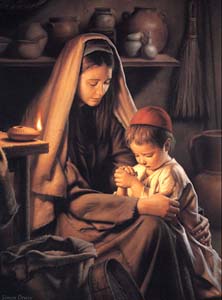
I decided to pray about these struggling souls, asking God what to think (or do) about them. His answer came quickly: “Take your cue from Jesus. What did he do about beggars?”

When I got home, I checked, and the one thing Jesus always did was help. But he inevitably connected it to faith in himself as God’s Son. He linked his practical gifts (such as healing) to the Gospel’s truth.

I thought back to Dad’s method of helping beggars, giving them the PGM cards. Because the mission offered worship services and presented the Gospel before meals, he had it right. His card was a ticket to both practical help and the truth of Jesus’ eternal healing.

So, what should Birgitta and I have done today? Gifts of money, hamburgers or hats would have been OK but incomplete. If we’re to follow Jesus’ example, a PGM card, a GettingThroughThis.com card or another piece of Scripture coupled with money, hamburgers or hats would have been much better.

Tangible gifts do help, but only temporarily. The powerful help of the Gospel goes on forever.

“Though [Jesus Christ] was rich, yet for your sake he became poor, so that you by his poverty might become rich.” (2 Corinthians 8:9b)
Making Preparations

Today is the Saturday after Thanksgiving, the day after Black Friday, and much of the country has begun its enthusiastic preparation for Christmas. For many years that was true for our family, too. We kept our 22 boxes of decorations under the stairs in a “secret” closet in which no adult could straighten up. It dictated assembly-line emptying of the decorations, smallest people farthest in.

Every family relishes the fun of opening their boxes again and pulling out Christmas items that mean something special only to them. It’s like participating in a private holiday festival, half silly and half magical.

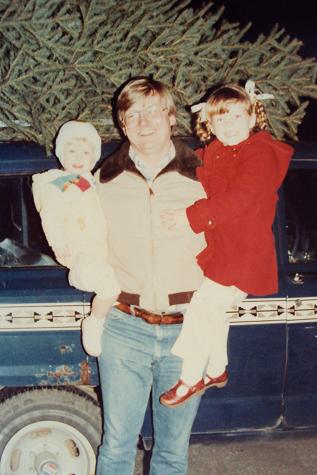
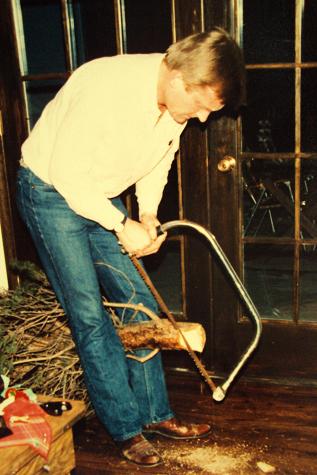
Nate was never big on setting out decorations or stringing lights. His enthusiasm was strongest for choosing the tree, sawing off the stump and getting it upright. He usually finished by wiring the trunk to the window behind it, hoping it wouldn’t “go overboard again this year.”

The rest of the family lost interest long before the tree was completely trimmed, but that never dimmed my holiday spirit. After they’d all been bathed and bedded down, and after Nate had settled into his nightly “bathtub hydrotherapy” with a good book, I’d head back to the boxes and put on my middle-aged-mom-music, decorating well into the night.

Today Birgitta and I did some shopping and enjoyed seeing newly purchased Christmas trees tied to the tops of cars heading home for the decorating ritual. Their ordinary evergreen would soon be transformed into a lighted, sparkling wonder, the focal point of their home for a month.

As we arrived home, our next door neighbors had finished decorating their pretty picket fence with garlands and lights, and in the twilight it was a welcoming sight. Last Christmas, seven weeks after Nate died, none of us were feeling merry. We did have a tiny, lopsided excuse-for-a-tree, but most of us were just hoping to “get Christmas over with.”

This Christmas will be different. Our “new family” will be together, which means we’ll be minus Nate but plus Micah, Evelyn and Thomas. Little children can serve as God’s instruments of joy, coaxing us to surrender to laughter and good cheer. Just imagining their expressions of glee at the ornaments and lights will make the decorating fun, even if I do it alone.

But while eagerly pulling out the boxes marked “Christmas”, I have to ask if I’m equally energized to ponder the magnificent coming of Christ. Have I lived through so many Christmases my subconscious tells me I know everything there is to know?

Jesus Christ, the Messiah of Christmas, has more depth to him than any of us can possibly comprehend. His interest in saving us, his unique way of accomplishing it and the love he expressed by becoming human are mind-boggling concepts we’ll think about throughout eternity.

As I decorate the house and yard, I’ve asked the Lord to show me something brand new about himself during this season.

And because I’ve prayed that, I’ll be eagerly anticipating his answer, watching for it, waiting for it and knowing it will come.

“The child [Jesus] grew and became strong; he was filled with wisdom, and the grace of God was on him.” (Luke 2:40)

Funny face

All of us have visited festivals or theme parks where street artists are sketching faces for money. Most often the drawings aren’t true to the person but are caricatures bearing similarities with exaggerated differences. The artists are quite good and most likely can draw faces accurately, but what makes it fun is producing pictures in which one facial detail is highlighted and drawn larger-than-life.

The artist first studies the face he’ll draw, looking for a dominant feature. Maybe it’s a turned up nose or freckles or heavy eyebrows. Then he creates a picture around that feature. Passers-by enjoy watching the face come to life on paper, chuckling as the artist reveals through charcoal or chalk what facial characteristic he’ll overstate.

The one being drawn nervously awaits the end result, knowing he or she will be paying for something that resembles their reflection in a fun-house mirror.

When I was in 7th grade, my family went on vacation, and my face was caricaturized. Although signing up for one of these drawings is risky and the end result often insulting, this artist was kind. I didn’t get a nose and my freckles were pronounced, but “Davo” gave me bright blue eyes and a lovely ponytail.

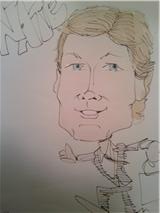
When Nate was a young lawyer in Chicago’s Loop, an acquaintance was practicing his cartooning and asked if he could draw a caricature of Nate. He, too, was kind, making Nate look like Robert Redford in an action movie. He gave him the jaw line of Superman and the heavy hair of a Kennedy, and we had the picture framed and hung for many years.

To me, the most interesting part of an artist’s caricature is the moment just before he puts chalk to paper when he’s studying the face in front of him to decide what feature(s) he’ll amplify. It reminds me of how we often see ourselves. We exaggerate certain features in our minds and think other people are judging us as a caricature rather than accepting the real us.

The other side of that dilemma is our looking at someone else and judging them unfairly based on one physical feature or even just one facet of their personality. I’m disgusted to say I sometimes do this, and I know God is highly displeased when I do.

What if the Lord looked at me that way? What if he said, “Margaret, you missed a chance to help your friend today; therefore you are a lazy, self-centered bum who never lifts a finger to help anyone. That’s how I see you.”

When I fall short, God may put me in a disciplinary situation but he is always and forever the God of new beginnings. Although he’s the one person who judges with complete accuracy 100% of the time, he sees me through the perfection of Jesus Christ and sets judgment aside because of that.

An artist creating a caricature looks at me with the desire to transform my face with humorous characteristics. God looks with a desire to transform me into a person of improved character. There’s a big difference.

Although an artist’s caricature-drawing is good for a few laughs, God’s character-building is serious improvement, good for all eternity.

“May you always be filled with the fruit of your salvation—the righteous character produced in your life by Jesus Christ.” (Philippians 1:11)